How Does Inflation Affect Savings? Free Online Inflation Calculator (2027)
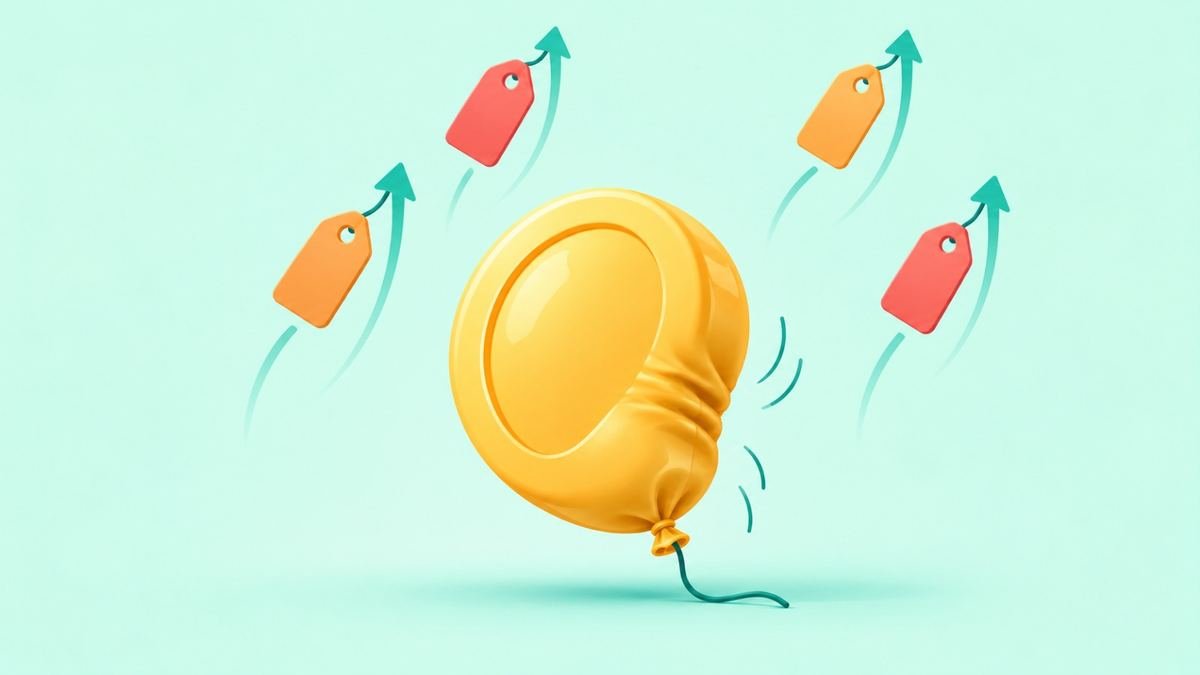
Your savings balance can go up while what it buys goes down. This free 2027 guide explains what inflation is, why it matters for savers, how to calculate its effect, when it hurts or helps, and whether it is good or bad. Estimate it for yourself with our free online inflation savings calculator.
Free online tool: use our free Inflation Savings Calculator. No signup, works on any phone.
What is inflation?
Inflation is the general rise in prices over time. When prices rise, each unit of money buys a little less than before. It is usually measured as a yearly percentage using a price index, for example the Consumer Price Index (CPI) published by the US Bureau of Labor Statistics ↗. Different countries use different measures, and the rate changes from year to year.
The related idea is purchasing power: what a given amount of money can actually buy.
Why does inflation matter for savings?
Because your savings are usually a fixed number of dollars. If prices rise 3% a year, the same $100 buys less every year. Here is what $100 today needs to become to keep the same buying power after 20 years:
- At 2% inflation: about $148.59.
- At 3% inflation: about $180.61.
- At 5% inflation: about $265.33.
Put another way, $100 held for 20 years at 3% inflation would have the buying power of only about $55 in today’s money.
How to calculate the effect of inflation
Two formulas cover most cases:
- Future amount needed = P × (1 + i)^t
- Purchasing power of P in future = P ÷ (1 + i)^t
where i is the yearly inflation rate and t is the number of years. To compare your interest with inflation, calculate the real return: (1 + interest rate) ÷ (1 + inflation) − 1. For example, 4.5% interest with 3% inflation gives a real return of about 1.46%, not 1.5% exactly, and the gap grows at higher rates.
A worked savings example
Suppose you put $10,000 in an account earning 4.5% a year for 10 years, with inflation at 3%.
- The balance grows to about $15,530.
- In today’s buying power, that is about $11,555.
- So the nominal gain is about $5,530, but the real gain is about $1,555.
Your balance rose by more than half, yet in real terms it rose by about 16%. That is the difference between nominal and real growth.
When does inflation hurt, and when does it help?
It hurts cash held for many years at an interest rate below inflation, and people on fixed incomes that do not rise with prices.
It can help borrowers with fixed-rate debt, because the real value of what they owe falls when prices rise, although this depends on their wages and rates rising too.
Timing matters: the longer the time frame, the bigger the effect. For a goal a year away, inflation is small. For a goal 20 years away, it is large.
Is inflation good or bad?
Neither in a simple way. Many economists regard low, stable inflation as normal in a healthy economy. High or unpredictable inflation is harmful because it erodes savings and makes planning difficult.
For a saver, the practical point is this: inflation is a cost to plan for. Your goal is not just to see a bigger number in your account, but to keep or grow what your money can buy.
How can savers respond?
- Compare the interest rate on savings with expected inflation, using the real return formula.
- Increase your contributions when your income rises.
- For long-term goals, raise the target amount to allow for price rises.
- Keep emergency money accessible, but review how much cash you hold for the long term.
- Consider speaking to a qualified professional about longer-term options that suit your own situation.
Common mistakes
- Judging savings only by the balance and not by buying power.
- Assuming inflation will stay at one fixed rate for decades.
- Forgetting that taxes on interest can widen the gap.
- Setting a goal in today’s prices for a date many years away.
Real return at a glance
The real return (interest adjusted for inflation) can be positive, zero or negative depending on the two rates:
- 4.5% interest, 3% inflation: real return about 1.46%.
- 3% interest, 3% inflation: real return about 0.00%, meaning buying power stays flat.
- 2% interest, 4% inflation: real return about −1.92%, meaning buying power falls even as the balance grows.
- 6% interest, 3% inflation: real return about 2.91%.
Checking this figure, rather than the interest rate alone, shows whether savings are actually getting ahead of rising prices.
Purchasing power over different time frames
At a steady 3% inflation, $10,000 held in cash (earning nothing) would have the buying power of about $8,626 after 5 years, $7,441 after 10 years, $6,419 after 15 years and $5,537 after 20 years. This is why cash meant for long-term goals is usually paired with some interest-bearing account, so growth has a chance to offset at least part of this effect.
Key takeaways
- Inflation reduces what a fixed amount of money can buy over time.
- The real return (interest minus inflation, roughly) shows whether savings are truly gaining ground.
- A balance can rise in dollar terms while its buying power falls, if the interest rate trails inflation.
- The effect grows the longer money is held, so it matters most for long-term goals.
- Treat any single inflation rate as an estimate, since it changes year to year.
If your income tends to rise roughly in line with prices each year, that growth can offset part of inflation’s effect on your ability to save, even if it does not directly change the buying power already sitting in your account. Reviewing both your savings rate and your interest rate at least once a year is a simple habit that keeps this risk in view rather than out of sight.
Frequently asked questions
How does inflation affect savings?
Rising prices reduce what your money can buy. If your interest rate is below inflation, the real value of your savings can fall even as the balance rises.
How much is $100 worth after 20 years at 3% inflation?
About $55 in today’s buying power, as an estimate.
What is a real interest rate?
The interest rate adjusted for inflation: (1 + interest) ÷ (1 + inflation) − 1.
Is there a free inflation savings calculator online?
Yes. Ours is free, needs no signup and estimates future amount needed and purchasing-power loss.
Is inflation good or bad?
Low, stable inflation is generally regarded as normal, while high inflation can erode savings. For savers, it is something to plan for.
What is a negative real return?
It happens when your interest rate is lower than inflation, meaning the buying power of your savings falls even though the account balance rises.
How much buying power does cash lose over 20 years at 3% inflation?
About 45%, since $10,000 would be worth roughly $5,537 in today’s buying power after 20 years at that rate.
Try these free calculators
Inflation Savings Calculator
Estimate how inflation could change purchasing power.
Calculate Now →College Savings Calculator
Compare projected savings with an inflation-adjusted college cost.
Calculate Now →