How to Set a Savings Goal and Reach It: Free Online Calculator (2027)

Saving works best when it has a target. This free 2027 guide explains what a savings goal is, why setting one helps, how to set one step by step, when to adjust it, and the good and bad sides of goals. Check your numbers with our free online savings goal calculator.
Free online tool: use our free Savings Goal Calculator. No signup, works on any phone.
What is a savings goal?
A savings goal is a specific amount of money you want to have by a specific date, for a specific purpose. “Save more” is a wish. “Save $6,000 for a trip in 18 months” is a goal: it has an amount, a deadline and a reason.
Goals fall into rough time frames: short term (under a year), medium term (one to five years) and long term (more than five years). The time frame affects how much you need to save each month and where it makes sense to keep the money.
Why does setting a goal help?
- Focus. A clear target makes it easier to say no to small, unplanned spending.
- Measurability. You can see progress. If you have saved $1,500 of a $6,000 goal, you are 25% there.
- Motivation. Milestones give you regular wins along the way.
- Realism. Doing the arithmetic tells you early whether the plan works.
How to set a savings goal, step by step
- Name the purpose. Be specific about what the money is for.
- Put a number on it. Research the real cost.
- Choose a date. Base it on when you actually need the money.
- Subtract what you have. Your current savings reduce the amount still needed.
- Work out the monthly amount. Use the free online savings goal calculator to include interest.
- Check affordability. If the number is too high, extend the date or lower the target.
- Automate and track. Set up a payday transfer and check progress monthly.
A worked example
Goal: $6,000 in 18 months, starting from nothing, in an account earning 4% a year.
- Without interest, you would save $333 a month.
- With 4% interest, the required amount falls to about $324 a month.
- If you already have $1,000, it falls to about $267 a month.
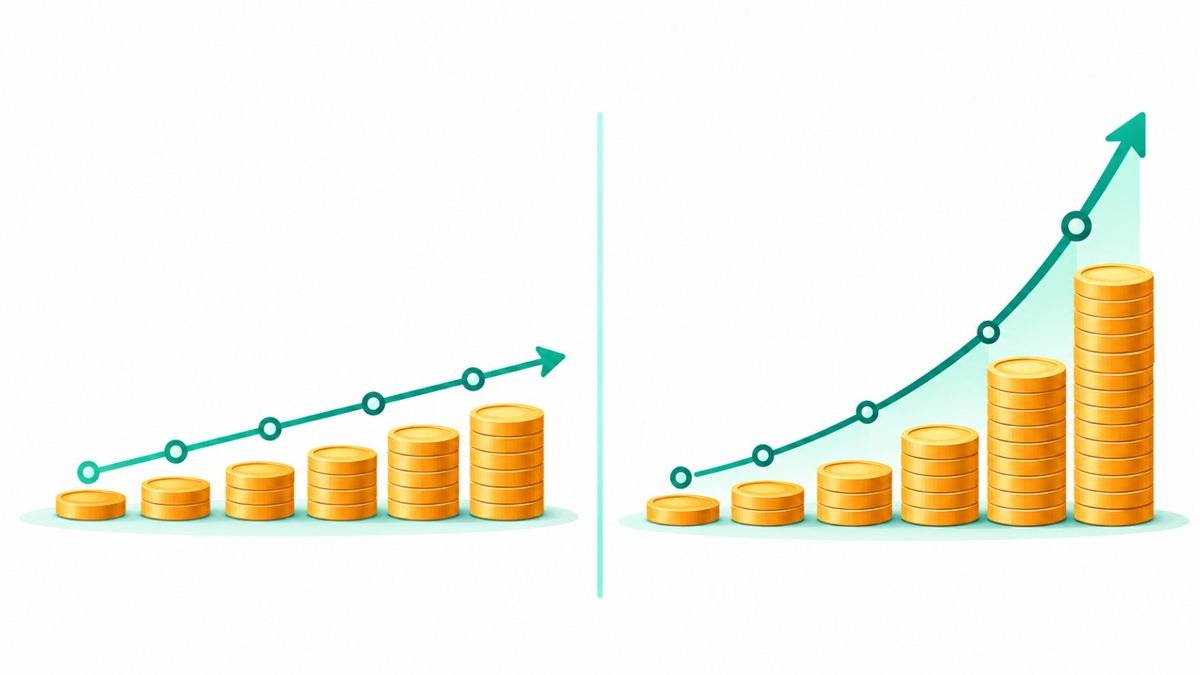
The difference from interest is modest over a short period, but it grows as the time frame gets longer. The current savings you have already put aside make a bigger difference than the interest does.
The reverse question: how long will it take?
Sometimes the monthly amount is fixed and the question is the date. Suppose your goal is $20,000, you have $2,000, and you can save $400 a month at 4%. The answer is about 42 months, or roughly three and a half years. Our savings goal calculator answers both questions: how much per month for a date, and how long for a monthly amount.
When should you adjust your goal?
Goals are not carved in stone. Consider adjusting when your income or costs change, when the price of what you are saving for changes, or when your priorities shift. For a goal that will be paid for in the future, remember inflation: something that costs $20,000 today could cost about $21,850 in three years at 3% inflation, so the target may need to rise.
Good or bad: the upsides and traps of goals
The good: clarity, discipline and satisfaction as you reach milestones.
The traps:
- Too many goals at once can spread money too thinly.
- An unrealistic goal may lead to giving up.
- Ignoring an emergency fund can turn a surprise into a raid on your goal savings.
- Treating a missed date as failure. Adjusting is not failing; it is planning.
Tips for staying on track
- Break long goals into yearly or quarterly milestones.
- Keep goal money in a separate account.
- Increase your monthly amount when your income rises.
- Celebrate milestones in a small, inexpensive way.
Setting more than one goal at a time
Many people are saving for several things at once, such as a $5,000 goal in 12 months and a separate $3,000 goal in the same 12 months, both starting at 4% interest. Treating them as two separate goal calculations gives a required contribution of about $409 a month for the first and about $203 a month for the second (which already has $500 saved toward it), for a combined total of about $612 a month. Calculating each goal on its own, rather than guessing at a combined number, avoids accidentally underfunding one of them.
How savings goals and an emergency fund fit together
It is common to wonder whether to build an emergency fund first or work on other goals at the same time. A reasonable approach many people use is to build a small starter emergency cushion first, then split further savings between the emergency fund and other goals until the cushion reaches its target. There is no single correct order; the aim is to avoid a goal-related purchase forcing you to raid emergency savings, and to avoid an emergency draining money meant for a planned goal.
Key takeaways
- A goal needs three parts: a specific amount, a purpose and a date.
- Subtract what you already have before dividing by the months left.
- Interest reduces the required contribution, more so over longer time frames.
- Multiple goals can be calculated separately, then added together for a combined monthly total.
- Adjusting a goal’s date or amount is normal planning, not a failure.
Frequently asked questions
How do I set a savings goal?
Choose a specific purpose, amount and date, subtract what you already have, then divide by the months remaining, adjusting for interest with a savings goal calculator.
Is there a free savings goal calculator online?
Yes. Ours is free, needs no signup and also tells you how long a set monthly amount will take.
How much should I save each month for my goal?
It depends on the target and date. For $6,000 in 18 months at 4% interest, about $324 a month.
What if my savings goal is not affordable?
Extend the date, lower the target, or raise your contribution gradually as your income allows.
Should I include inflation in my savings goal?
For goals with a price that may rise, yes. Increase the target by an estimated inflation rate over the time frame.
Can I have more than one savings goal at the same time?
Yes. Calculate each goal separately with its own target, date and current savings, then add the required monthly amounts together to see the combined total.
Should I finish my emergency fund before saving for other goals?
Many people build a small starter emergency fund first, then save toward other goals alongside continuing to grow the emergency fund, but there is no single right order for everyone.
Try these free calculators
Savings Goal Calculator
Find out how much to save to reach a target, or how long a set contribution will take.
Calculate Now →Inflation Savings Calculator
Estimate how inflation could change purchasing power.
Calculate Now →College Savings Calculator
Compare projected savings with an inflation-adjusted college cost.
Calculate Now →