
Compound Interest Calculator 2027: Free Online Tool
Watch principal, contributions and interest build on each other over time.
Use the free compound interest calculator above to see how a principal amount grows when interest is calculated on top of interest, not just on your original deposit. This online compound interest calculator also lets you add regular contributions, so it works whether you are testing a single lump-sum deposit or an ongoing savings plan.
Below, we explain what compound interest actually is, show the formula, and walk through real, checkable examples, including how much difference the compounding frequency really makes (spoiler: less than most people expect).
Formula and assumptions
A = P(1 + r/m)^(mt) for the principal, plus the future value of each contribution: C × ((g^n − 1)/(g − 1)), g = (1 + r/m)^(m/f). Contributions at end of period.
Estimates only. Actual growth can differ because rates may change, taxes may apply, and institutions may calculate interest differently.
What Is Compound Interest?
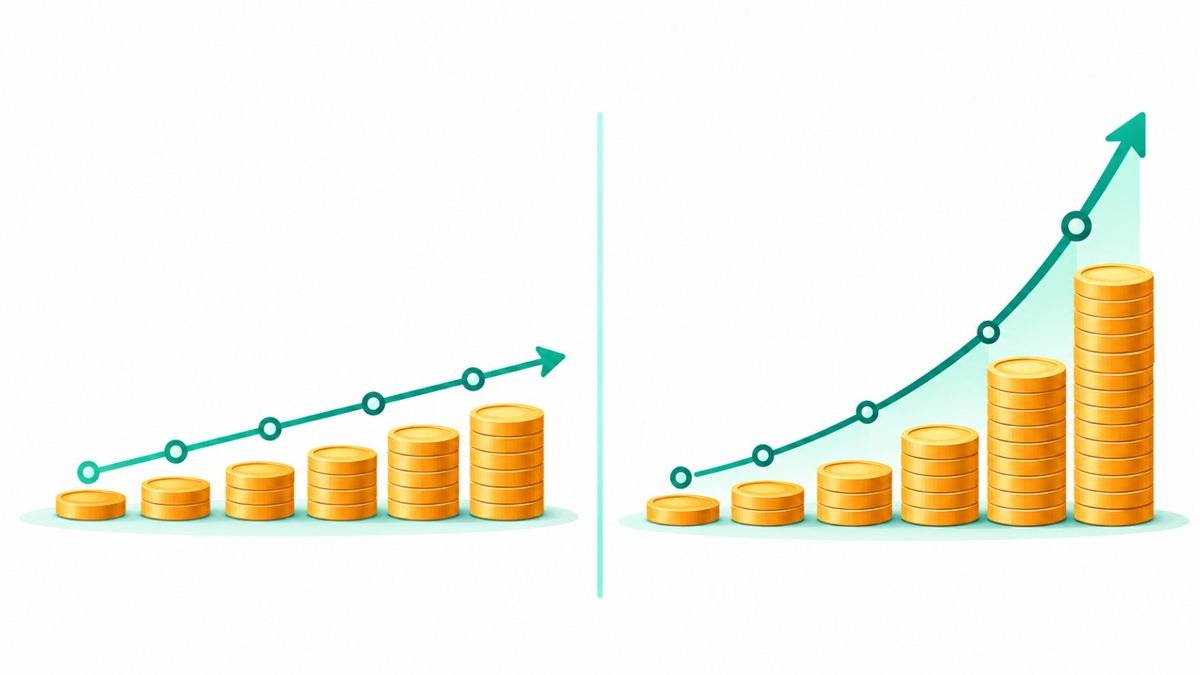
Compound interest is interest calculated on both your original principal and on the interest that has already been added to your balance. This is different from simple interest, which is always calculated only on the original amount. Because each round of interest becomes part of the balance that earns the next round of interest, growth accelerates over time rather than staying flat — often described as "interest on interest."
This compound interest calculator is built for anyone who wants to see that acceleration in real numbers: a saver comparing a 5-year plan against a 20-year plan, a student learning the concept for a finance class, or someone deciding whether a slightly higher advertised rate is actually worth switching accounts for.
How Does the Compound Interest Calculator Work?
You provide a principal (your starting amount), an interest rate, a compounding frequency (how often interest is added to the balance — daily, monthly, quarterly, semi-annually, or annually), and a time period in years. Optionally, you can also add a regular contribution and its frequency, in which case the calculator combines lump-sum compounding with the future value of a contribution series.
Internally, the calculator grows the balance one compounding period at a time: each period, the current balance is multiplied by (1 + rate ÷ compounding periods per year), and if a contribution falls due in that period, it is added in. This period-by-period approach is what allows the calculator to show a full year-by-year table underneath your result, not just a single final number.
Compound Interest Formula
For a principal with no ongoing contributions, the standard compound interest formula is:
A = P × (1 + r/n)nt
- A = the final amount (principal plus interest)
- P = the principal (starting amount)
- r = the annual interest rate (as a decimal, so 5% is 0.05)
- n = the number of times interest compounds per year
- t = the number of years
When you add regular contributions, the calculator also adds the future value of those contributions: C × [((1 + r/n)nt − 1) / (r/n)], where C is your contribution amount per compounding-aligned period. Adding these two parts together gives the combined result shown on the calculator.
How to Use the Compound Interest Calculator
- Enter your principal — the amount you are starting with.
- Enter your interest rate. If you only have an APY, switch "Rate type" to APY so it is converted correctly.
- Choose your compounding frequency, matching your bank or account statement if you have one.
- Enter the number of years you want to project.
- Optionally, add a contribution amount and how often you plan to add it.
- Read your result: final balance, total contributed, and interest earned, plus the year-by-year table.
Compound Interest Calculator Example
Example 1 — lump sum only. $10,000 invested at 5%, compounded monthly, for 10 years, with no further contributions:
| Input | Value |
|---|---|
| Principal | $10,000 |
| Interest rate | 5% (monthly compounding) |
| Time period | 10 years |
Result: the balance grows to about $16,470 — $10,000 of principal plus $6,470 of compound interest, without a single extra deposit.
Example 2 — with contributions. The same $10,000, but now adding $200 a month, at the same 5% for a longer 20-year period, grows to about $109,333: $58,000 came from contributions (the $10,000 principal plus 240 monthly deposits of $200), and $51,333 came from compound interest — nearly half of the final balance.
A small beginner example: $500 at 3% for 2 years, no contributions, grows to about $531 — just $31 of interest, which shows why compounding needs either a larger balance, a higher rate, or more time to become dramatic.
Why Use This Compound Interest Calculator?
- It removes guesswork. Compound growth is not intuitive — most people underestimate how much a rate difference matters over 20+ years and overestimate it over 1–2 years.
- It tests compounding frequency directly. You can see for yourself whether "daily compounding" is worth chasing compared to monthly (usually, it is a small difference — see the table below).
- It combines lump sums and contributions in one tool, rather than forcing you to add two separate calculations together by hand.
When Should You Use a Compound Interest Calculator?
- Comparing two account offers with different rates and compounding schedules, to see the real dollar difference rather than just the headline percentage.
- Deciding whether to add a lump sum (like a bonus or tax refund) to an existing balance now, versus spreading it out.
- Understanding a finance concept for school or work, using round numbers you can check by hand against the formula above.
- Long-range planning, such as projecting a 20 or 30-year investment horizon, where compounding effects are largest.
What Does the Result Mean?
The main result shows your final balance, total contributions (your principal plus any deposits), and interest earned (the difference between the two). A useful way to read this: the ratio of interest earned to total contributions tells you how much of your final balance is "free" growth versus money you actually put in yourself. In Example 2 above, that ratio was nearly 1-to-1 — interest earned almost matched total contributions, purely because of the 20-year time frame.
Common Mistakes When Using a Compound Interest Calculator
- Overestimating the effect of compounding frequency. As the table below shows, the jump from annual to daily compounding at 5% over 10 years on $5,000 is under $100 — the interest rate and time period matter far more.
- Forgetting to convert a percentage to match the tool. If you are checking the formula by hand, remember r must be a decimal (5% = 0.05), not the whole number 5.
- Ignoring fees. Some accounts or investment products charge fees that reduce your effective rate; the calculator does not know about fees unless you build them into the rate you enter.
- Assuming the rate stays constant. This calculator assumes one fixed rate for the whole period; variable-rate accounts and market-linked investments will not behave this predictably in reality.
Compounding frequency comparison, $5,000 at 5% for 10 years, no contributions:
| Compounding | Final balance |
|---|---|
| Annually | $8,144 |
| Semi-annually | $8,193 |
| Quarterly | $8,218 |
| Monthly | $8,235 |
| Daily | $8,243 |
Tips for Maximizing Compound Interest
- Time matters more than almost anything else. Starting five years earlier usually beats finding a 1% higher rate — test both scenarios in this calculator to see for yourself.
- Reinvest interest rather than withdrawing it. Compounding only accelerates growth if the interest stays in the account.
- Add contributions when you can. As Example 2 shows, ongoing deposits can contribute more to your final balance than the interest itself in the early years.
- Do not chase compounding frequency alone. A 4.9% APY compounded daily can lose to a 5.1% APY compounded monthly — always compare using APY, not the raw rate and frequency separately.
Related Financial Concepts
- Simple interest — interest calculated only on the principal, never on prior interest. Compare using our Simple Interest Calculator or read Simple vs Compound Interest.
- APY — the effective annual return once compounding is included, which is the fairest way to compare two accounts with different compounding schedules. Try the APY Calculator.
- Future value — the general financial concept this calculator is built on: what a sum of money today (plus any contributions) will be worth at a future date, given a rate of growth.
- Rule of 72 — a quick mental shortcut (72 ÷ rate) to estimate how many years it takes an investment to double under compound interest.
Frequently asked questions
Is this compound interest calculator free?
Yes, completely free with no signup, and it runs entirely in your browser.
What is the compound interest formula?
A = P(1 + r/n)^(nt), where P is principal, r is the annual rate as a decimal, n is compounding periods per year, and t is time in years. Adding regular contributions adds a second term for their future value.
Does compounding frequency make a big difference?
Usually only a small one. On $5,000 at 5% for 10 years, moving from annual to daily compounding changes the result by under $100 — the rate and time period matter far more than compounding frequency.
Can I include monthly contributions in this calculator?
Yes. Enter a contribution amount and choose its frequency, and the calculator adds the future value of those contributions to the principal's growth.
What is the difference between compound interest and simple interest?
Simple interest is calculated only on your original principal. Compound interest is calculated on your principal plus all interest already earned, so it grows faster over time. See our detailed comparison.
How much will $10,000 grow in 10 years with compound interest?
It depends on the rate. At 5% compounded monthly with no further deposits, $10,000 grows to about $16,470 — $6,470 of interest.
Is daily compounding always better than monthly?
For the same stated interest rate, yes, daily compounding produces a very slightly higher result than monthly. But two accounts rarely have the exact same rate, so always compare using APY rather than assuming daily compounding wins.
What is the Rule of 72?
A quick estimate for how long it takes money to double under compound interest: divide 72 by the interest rate. At 6%, that is roughly 12 years.
Does this calculator account for taxes?
No, the result is shown before tax. Interest earned may be taxable depending on your country and account type.
Can I use this for an investment instead of a savings account?
The maths works for any compounding scenario, but keep in mind that investment returns are not usually guaranteed or constant the way a fixed savings rate is — treat investment projections as illustrative, not predictive.
Guides for this calculator


Related calculators
Savings Goal Calculator
Find out how much to save to reach a target, or how long a set contribution will take.
Calculate Now →Monthly Savings Calculator
Project future savings from a fixed monthly contribution.
Calculate Now →Weekly Savings Calculator
Project future savings from weekly contributions.
Calculate Now →Daily Savings Calculator
See what small daily contributions can add up to.
Calculate Now →