
Simple Interest vs Compound Interest: Difference With Examples (Free Calculators, 2027)
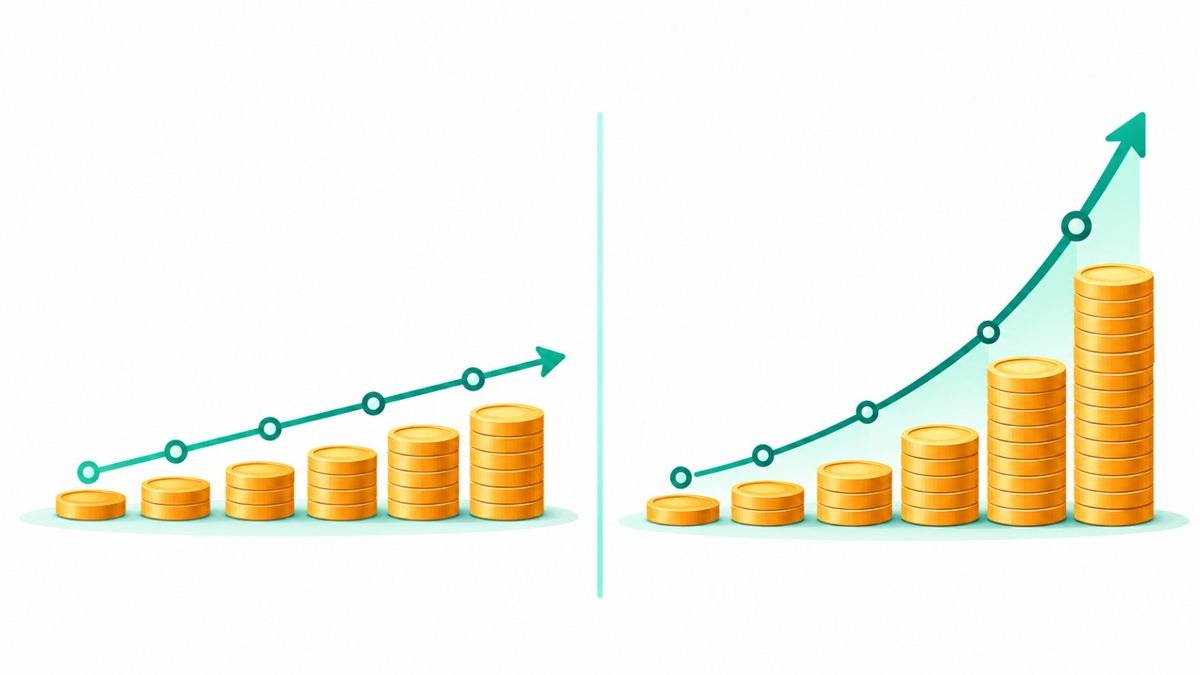
Simple interest and compound interest sound similar but behave very differently over time. This free 2027 guide explains what each one is, why the difference matters, how to calculate both, when you will meet each, and which is good or bad depending on whether you save or borrow. Try both with our free online calculators.
Free online tool: use our free Simple Interest Calculator. No signup, works on any phone.
What is simple interest?
Simple interest is calculated only on the original amount (the principal). The interest for each period stays the same because it is never added to the base. The formula is Interest = P × r × t, and the total amount is A = P(1 + rt), where P is the principal, r is the yearly rate as a decimal and t is the time in years.
Example: $10,000 at 5% for 3 years earns $10,000 × 0.05 × 3 = $1,500, so the total is $11,500.
What is compound interest?
Compound interest is calculated on the principal and on interest already added. Each period the base grows, so each period earns a little more than the last. The formula for interest compounded n times a year is A = P(1 + r/n)^(nt).
Same example, compounded annually: $10,000 × 1.05³ = $11,576, so the interest is about $1,576, or $76 more than simple interest after three years.
Why does the difference matter?
After one period, the two methods give the same result. The gap appears and then widens as time passes. Using $10,000 at 5% (compounded annually) as an example:
- 3 years: simple $11,500 vs compound about $11,576.
- 10 years: simple $15,000 vs compound about $16,289.
- 30 years: simple $25,000 vs compound about $43,219.
The longer the time, the more the difference grows. That is why the term of a savings plan or a loan can matter as much as its rate.
How to calculate each, step by step
- Write down the principal, the annual rate and the time in years.
- Convert the rate to a decimal (5% becomes 0.05).
- For simple interest, multiply P × r × t.
- For compound interest, decide how often interest is added (yearly, monthly, daily), then use A = P(1 + r/n)^(nt).
- Subtract the principal from A to get the interest earned.
Or skip the arithmetic: our free online simple interest and compound interest calculators do it instantly and show a year-by-year table.
When will you meet each type?
Simple interest appears in some short-term loans and in some loans where interest is calculated daily on the outstanding balance, such as certain car loans. Compound interest appears in most savings accounts, certificates of deposit and credit cards. Terms vary by product and country, so read the small print or ask your provider how interest is calculated.
Good or bad? It depends on which side you are on
As a saver: compound interest is generally the better deal, because interest earns interest. Simple interest on savings would mean slower growth.
As a borrower: the reverse. Simple interest usually costs less, because interest is never charged on interest. For example, borrowing $5,000 at 8% for 2 years costs $800 in simple interest, or $832 if compounded annually. Over longer periods, or with monthly or daily compounding, the difference rises.
The fair summary: compound interest is good when it is working for you and less good when you owe it.
Frequency of compounding: how much does it matter?
The more often interest is added, the higher the result, but with diminishing returns. $10,000 at 5% for 10 years ends at about $16,289 compounded annually, $16,470 monthly and $16,487 daily. Choosing an account with better terms usually matters more than the compounding schedule.
Common mistakes
- Assuming a “5% rate” means the same thing on a loan and on a savings account.
- Multiplying a monthly rate by 12 and treating it as an annual compounded figure.
- Comparing a simple-interest offer with a compound one without calculating both.
- Ignoring the time period, which is where compounding has most effect.
The gap over more time periods
Extending the $10,000 at 5% example across several time frames shows how the gap between simple and compound interest widens:
- 5 years: simple $12,500 vs compound $12,763 (difference $263)
- 10 years: simple $15,000 vs compound $16,289 (difference $1,289)
- 20 years: simple $20,000 vs compound $26,533 (difference $6,533)
- 30 years: simple $25,000 vs compound $43,219 (difference $18,219)
The difference is small in the early years and becomes large later, which is why the “which is better” question depends heavily on how long the money is left in place.
A borrowing example
Borrowing $5,000 at 8% for 3 years with no payments during the term: under simple interest the balance grows to $6,200, but under monthly compounding it grows to about $6,351, or $151 more. Loan terms vary, so always check whether a quoted rate on a loan is simple or compounded, and how often, before comparing offers.
Key takeaways
- Simple interest is calculated only on the original principal; compound interest is calculated on the balance including past interest.
- The two give the same result after one period, then compound interest pulls ahead as time passes.
- As a saver, compounding generally works in your favor; as a borrower, it generally works against you.
- Compounding frequency matters far less than the rate and the length of time involved.
- Always check which method a specific loan or account actually uses before comparing offers.
If you are choosing between two account offers right now, run both through our Simple Interest and Compound Interest calculators with your real numbers rather than relying on the examples above, since the gap between the two methods depends heavily on your own rate and time frame.
Frequently asked questions
What is the difference between simple and compound interest?
Simple interest is calculated only on the original amount. Compound interest is calculated on the balance including previously added interest.
Which earns more, simple or compound interest?
For the same rate and time, compound interest earns more once more than one period has passed.
Is compound interest bad for loans?
For borrowers it usually costs more than simple interest, because interest is charged on interest already owed.
Are there free online calculators for both?
Yes. Our simple interest and compound interest calculators are free, need no signup and show results instantly.
What is the simple interest formula?
A = P(1 + rt), so interest = P × r × t.
Does the gap between simple and compound interest keep growing over time?
Yes. In the $10,000 at 5% example, the gap grows from about $263 after 5 years to over $18,000 after 30 years.
How much more expensive is compound interest on a loan?
It depends on the rate, compounding frequency and term; in the $5,000 at 8% for 3 years example, monthly compounding added about $151 versus simple interest.
Try these free calculators
Simple Interest Calculator
Interest calculated on the original principal only.
Calculate Now →Compound Interest Calculator
Watch principal, contributions and interest build on each other over time.
Calculate Now →