How to Create a Monthly Budget in 6 Simple Steps
To create a monthly budget, write down your take-home pay, list your fixed and flexible costs, and decide how much to save first. Then give the rest a job. A simple start is 50% for needs, 30% for wants and 20% for savings. Check your budget once a week and adjust it every month.
- A monthly budget is a plan for your money. It tells every dollar where to go.
- Start with take-home pay, not your salary before tax.
- Use a simple split like 50/30/20, then change it to fit your life.
- Pay your savings first, so it does not get spent by mistake.
- Saving $300 a month at an example 4% rate could grow to about $44,175 in 10 years.
- Review your budget every week for 10 minutes. Reset it every month.
If you want to know how to create a monthly budget, the good news is that it is easier than it sounds. A budget is just a plan for your money. You decide where it goes before the month starts, instead of wondering where it went at the end.
This guide shows you six simple steps. We use plain words and one clear example, so you can follow along with a pen, a notebook or a spreadsheet. Every number is an example. Your income and costs will be different, and that is fine.
What is a monthly budget and why does it matter?
A monthly budget is a list of the money you expect to get and the money you plan to spend in one month. It has two sides. On one side is your income. On the other side are your costs and your savings.
The goal is simple: the two sides should match. When your plan uses all of your income, nothing is left to disappear by accident.
Here is why a budget helps:
- You see the full picture. Many people guess their spending and guess too low.
- You stop small leaks. Little costs, like snacks or apps, add up fast.
- You can save on purpose. Savings becomes a bill you pay to yourself.
- You feel calmer. Knowing the plan makes money less scary.
A budget is not a punishment. It is a tool that lets you spend without guilt, because you already decided how much is safe to spend.
Tip: Think of a budget as a map, not a cage. A map shows you where you can go. It does not stop you from having fun.
How do you create a monthly budget in 6 steps?
Here is the whole plan in one list. The next sections explain each step with an example.
- Find your take-home pay.
- List your fixed costs (bills that stay the same).
- List your flexible costs (bills that change).
- Choose your savings amount first.
- Give the rest a job.
- Check it every week and reset it every month.
You can finish steps 1 to 5 in about one hour. After that, the budget takes only a few minutes each week.
Step 1: What is your take-home pay?
Your take-home pay is the money that reaches your bank account after taxes and other deductions. Do not use your salary before tax. You cannot spend money you never receive.
If you are paid every two weeks, remember that some months have three paychecks. Use the lower number for your normal month and treat the third paycheck as a bonus for savings.
If your income changes, look at the last six months. Pick the lowest normal month and use that as your base. Any extra can go to savings or goals.
For our example, we will use a person named Sam. Sam takes home $3,000 a month.
Step 2: What are your fixed costs?
Fixed costs are bills that stay about the same every month. They are easy to plan because you know the amount in advance.
Common fixed costs are:
- Rent or mortgage
- Car payment
- Insurance
- Phone and internet
- Minimum debt payments
- Subscriptions you want to keep
Look at your bank app for the last two or three months. Write down each bill and its amount. Add them up.
Here are Sam's fixed costs:
| Fixed cost | Per month |
|---|---|
| Rent | $1,100 |
| Phone and internet | $90 |
| Insurance | $120 |
| Car payment | $180 |
| Minimum debt payment | $60 |
| Total fixed costs | $1,550 |
Step 3: What are your flexible costs?
Flexible costs change from month to month. Some are needs, like food and fuel. Others are wants, like eating out and fun.
Look at the last 30 to 60 days of spending. Add up what you spent in each group. Do not judge yourself. You are only collecting facts.
Here are Sam's flexible costs:
| Flexible cost | Per month |
|---|---|
| Groceries | $380 |
| Fuel or transport | $140 |
| Utilities (power, water) | $110 |
| Eating out | $150 |
| Fun and hobbies | $120 |
| Clothes and personal care | $90 |
| Other and surprises | $100 |
| Total flexible costs | $1,090 |
Now add the two totals. Sam spends $1,550 plus $1,090, which is $2,640 a month. Sam's take-home pay is $3,000. That leaves $360.
A lot of people do not know where that $360 goes. In many cases, it slowly disappears into small purchases. A budget gives it a job.
Step 4: How much should you save first?
This is the most important step. Decide how much you will save before you decide how much you will spend. This idea is often called "pay yourself first."
If you save what is left at the end of the month, you will often have nothing left. If you save first, the rest of the budget has to fit around it.
A simple starting point is the 50/30/20 rule:
- 50% for needs
- 30% for wants
- 20% for savings
You can read more about this idea in our guide to how much you should save each month.
For Sam, 20% of $3,000 is $600. That is more than Sam can do right now, because $3,000 minus $2,640 is only $360 of room. So Sam starts at $300 a month, which is 10%. That is a real plan Sam can keep.
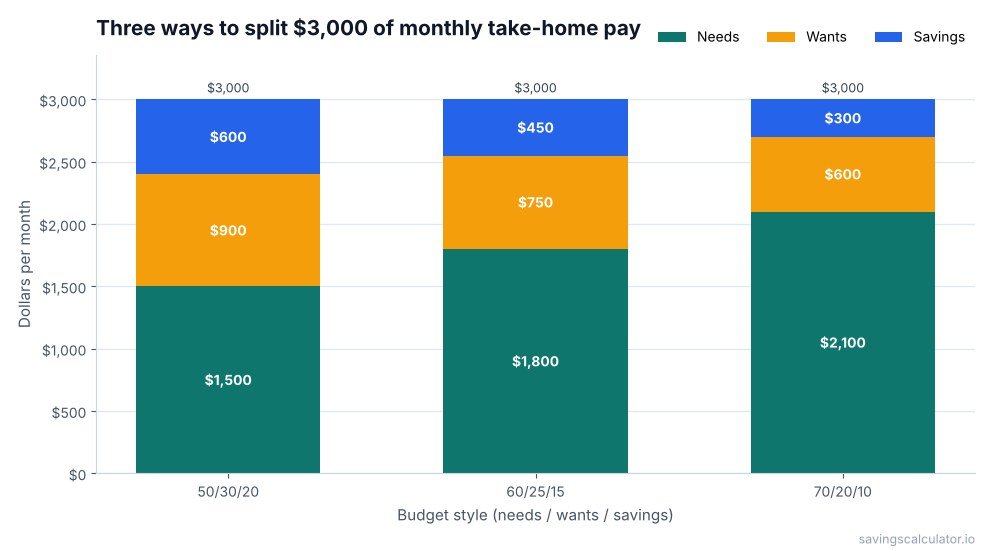
The chart shows that there is no single right split. If your rent is high, you may need the 70/20/10 version for a while. That is okay. A small habit you keep beats a big plan you quit.
Example: Quick check: Sam wants to save $300 a month. Divide $300 by $3,000. The answer is 0.10, or 10%. Sam is saving 10% of take-home pay.
Step 5: How do you give every dollar a job?
Now put it all together. Take your take-home pay and subtract your savings. Then subtract your fixed costs and your flexible costs. The result should be zero or close to it.
Here is Sam's finished budget:
| Category | Amount | Share of pay |
|---|---|---|
| Take-home pay | $3,000 | 100% |
| Savings | $300 | 10% |
| Fixed costs | $1,550 | 52% |
| Flexible costs | $1,090 | 36% |
| Left over | $60 | 2% |
Sam has $60 left. Sam can put that in a small "oops" category for surprises, or add it to savings. Either choice is fine.
If your total is too high, look at flexible costs first. They are easier to change than rent or insurance. Cut a little from several places instead of a lot from one place. For example, trim eating out by $30 and fun by $20.
If your total is still too high, check your fixed costs. Can you lower your phone plan? Can you shop for cheaper insurance? Even a few dollars help.
Watch out: Do not forget costs that come only a few times a year, like car repairs, gifts and annual fees. Divide each one by 12 and set that money aside every month. This is called a sinking fund.
What does $300 a month turn into?
Many people think small amounts do not matter. Let us see if that is true.
Say Sam saves $300 every month in an account that pays an example 4% a year. The table shows what could happen. We assume deposits at the end of each month and monthly compounding.
| Years | Money Sam puts in | Balance with interest |
|---|---|---|
| 1 | $3,600 | $3,667 |
| 3 | $10,800 | $11,454 |
| 5 | $18,000 | $19,890 |
| 10 | $36,000 | $44,175 |
After 10 years, Sam has put in $36,000. Interest adds about $8,175 more. The longer you save, the more the interest helps.
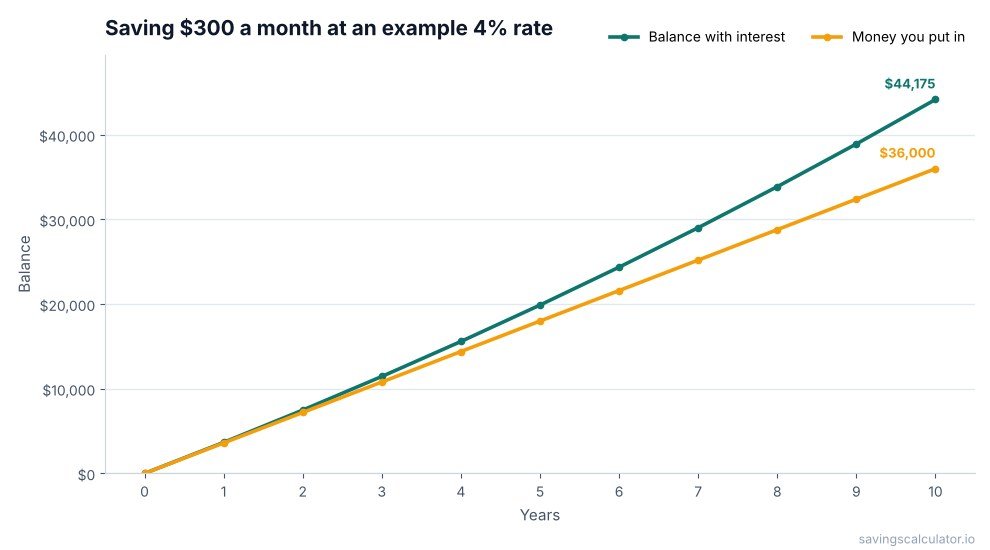
You can test your own numbers with our free monthly savings calculator. Change the amount, the rate and the years, and watch the result change. If you have a target in mind, the savings goal calculator tells you the exact amount to save each month.
Put your own numbers into our free Monthly Savings Calculator. No signup. Works on any phone.
Step 6: How do you check your budget every week?
A budget only works if you look at it. Plan a short weekly check-in. Pick a day, set a timer for 10 minutes and do three things:
- Look at your spending for the week.
- Compare it to your plan. Are you above or below in each category?
- Move money if needed. If you overspent on food, take a little from fun.
At the end of the month, do a bigger reset. Ask yourself:
- Did I reach my savings amount?
- Which category was too small or too big?
- Did any new bills appear?
- Can I raise my savings by even $10 or $20?
Then build next month's budget from what you learned. Each month it gets easier and more accurate.
Tip: Set your savings transfer for the day after payday. When the money moves on its own, you do not need willpower. Our guide on how to start saving money shows how to set this up.
What are the most common budgeting mistakes?
Most people make the same few mistakes. Knowing them early makes them easy to avoid.
- Making the budget too strict. If there is no money for fun, you will quit. Always plan a small fun amount.
- Forgetting irregular costs. Car repairs, gifts and annual bills ruin many budgets. Plan for them monthly.
- Using gross pay. Always start with take-home pay.
- Guessing instead of checking. Look at real bank records for at least one month.
- Skipping the check-in. A budget you never look at is just a piece of paper.
- Giving up after one bad month. Every budget needs a few rounds of fixes. That is normal.
- Having no buffer. A small "other" category of $50 to $100 keeps you from feeling like you failed.
Which budgeting method should you pick?
There are many ways to budget. All of them aim for the same goal: a plan that matches your income. Here are three popular ones.
| Method | How it works | Good for |
|---|---|---|
| 50/30/20 | Split pay into needs, wants and savings | Beginners who want a simple rule |
| Zero-based | Give every dollar a job until you reach $0 | People who like detail |
| Envelope | Put a limit on each category and stop when it is gone | People who overspend on small things |
You can mix them. For example, use 50/30/20 to choose your big categories, then use zero-based budgeting to fill in the details. Pick the style that feels easy. The best method is the one you will actually use.
What should you do next?
You now have everything you need. Here is a short list for this week:
- Write down your take-home pay.
- Add up your fixed costs from the last two months.
- Add up your flexible costs from the last 30 days.
- Choose a savings amount, even if it is only $25.
- Set up an automatic transfer for the day after payday.
- Put a weekly 10-minute check-in on your calendar.
Your first budget will not be perfect. That is okay. Each month you will learn something new, and your plan will get better. In a few months, budgeting will feel like a normal habit instead of a chore.
Frequently asked questions
What is the easiest way to create a monthly budget?
Write down your take-home pay. Then list your must-pay bills, your flexible spending and a savings amount. Make sure the total is not more than your income. A simple rule like 50/30/20 is a good first draft.
How much of my income should go into a budget for savings?
Many people start with 10% to 20% of take-home pay. If that feels too big, start with 1% to 5% and raise it over time. Our guide on how much to save each month can help you pick a number.
Should I budget with my gross or net income?
Use your net income, also called take-home pay. This is the money that actually lands in your bank account after taxes and other deductions. You can only spend what you receive.
What if my income changes every month?
Build your budget on your lowest normal month. When you earn more, add the extra to savings or to a goal. This keeps your must-pay bills safe in slow months.
How often should I update my budget?
Check it once a week for about 10 minutes. Do a full reset once a month. Also update it when something big changes, like a new job, a new bill or a move.
What is the best budgeting app?
There is no single best app. A notebook, a spreadsheet and a free app all work. The best tool is the one you will open every week.
What should I do if I overspend in one category?
Move money from another category, so the total stays the same. Do not give up on the whole budget. One bad week is normal, and you can start again the next day.
How do I make a budget when I live with a partner?
Talk about shared bills first, then each person's own spending money. Many couples keep one joint list of bills and a small personal amount each. Review it together once a month.
Please note: This guide is for education only and is not personal financial, tax or legal advice. Numbers in examples are simple estimates, not promises. Rates, fees and rules change, so check with your bank or a qualified adviser before you decide. See our disclaimer.
Keep reading

Related calculators
Monthly Savings Calculator
Project future savings from a fixed monthly contribution.
Calculate Now →Savings Goal Calculator
Find out how much to save to reach a target, or how long a set contribution will take.
Calculate Now →Savings Calculator
See how your savings could grow with regular contributions and compound interest.
Calculate Now →Compound Interest Calculator
Watch principal, contributions and interest build on each other over time.
Calculate Now →