How to Start Saving Money: A Simple 7-Step Plan for Beginners
If you want to know how to start saving money, the answer is simple: pick a small amount, move it to a separate account, and let it happen on its own. You do not need a big paycheck. You do not need a perfect budget. You need a plan small enough that you will actually follow it.
This guide gives you a 7-step plan for 2027. Each step takes a few minutes. By the end, you will have a starting amount, a safe place to keep your money, and a first goal of $500.
We use plain words and real numbers you can check by hand. Every figure here is an example. Your rates and income will differ, so treat the numbers as a guide, not a promise.
To start saving money, pick a small amount, such as 1% to 5% of your take-home pay. Open a separate savings account, and set an automatic transfer for the day after payday. Aim for a first goal of $500, then raise the amount a little every few months.
- Start small. A habit you keep beats a big plan you drop.
- Try 1% to 5% of take-home pay as a starting amount.
- Keep savings in a separate account, and automate the transfer after payday.
- At $25 a week, your first $500 takes 20 weeks.
- $50 a week could grow to about $14,365 in 5 years at an example 4% rate.
- Raise the amount a little every few months.
Why is it hard to start saving money?
Most people think saving means giving up everything fun. So they set a huge goal, last two weeks, and quit. That is not a character flaw. It is just a plan that was too big.
The fix is to start so small that it feels almost silly. A habit you keep at $10 a week beats a plan you drop at $200 a week. Once the habit is in place, you can raise the amount.
Three common blockers
- "I don't earn enough." Even $5 a week builds the habit and adds up to $260 in a year.
- "I don't know where my money goes." Step 1 below fixes that in about 20 minutes.
- "Saving feels pointless." A first $500 buffer makes small surprises much less stressful.
Time also helps you. Money you save earlier has longer to earn interest. Our guide on how compound interest works shows why a small start still matters.
What is the simplest plan to start saving money?
Here is the whole plan in one list. The next sections explain each step.
- Look at your last 30 days of spending.
- Find a starting amount you can afford.
- Open a separate savings account just for this money.
- Automate the transfer for the day after payday.
- Aim for a first $500 milestone.
- Protect the money from everyday spending.
- Raise the amount a little every few months.
Notice that the plan does not start with a budget. It starts with a quick look at what already happens. You can build a full budget later.
The steps also run in order for a reason. Looking first tells you what is realistic. A separate account keeps the money out of sight. Automation removes the need for willpower. The rest keeps you going.
Most people can finish steps 1 to 4 in one evening. After that, the plan runs mostly by itself.
How much should you save when you are just starting?
Step 1: Look at the last 30 days
Open your bank app and scroll through the last month. Write down what you paid for rent, food, transport, bills and everything else. You are not judging. You are just looking.
Circle anything you did not need or barely remember. Small, repeated costs are often the easiest to trim.
Step 2: Pick a starting amount
A friendly rule is to start with 1% to 5% of your take-home pay. Take-home pay is the money that lands in your account after taxes. If that feels easy, move toward 10% later. Our article on how much to save each month goes deeper on bigger targets.
Here is what that looks like for someone who takes home $2,400 a month. We assume a savings account that pays 4% a year, as an example.
| Share of pay | Per month | Put in over 1 year | Balance after 1 year |
|---|---|---|---|
| 1% | $24 | $288 | about $293 |
| 5% | $120 | $1,440 | about $1,467 |
| 10% | $240 | $2,880 | about $2,933 |
All three work as a start. The best one is the one you can keep up when the month gets tight.
Worked example: what does $50 a week turn into?
Say Maya decides to save $50 every week. That is $2,600 in a year. Let us see how much it grows with a savings account that pays an example rate of 4%.
Step 1: Turn weekly into monthly. $50 × 52 weeks ÷ 12 months = about $216.67 a month.
Step 2: Work out the monthly rate. 4% ÷ 12 = 0.333% each month.
Step 3: Repeat the formula 12 times. After month 1 the balance is $216.67. After month 2 it is about $434.06. It keeps growing each month.
Result: after 12 months Maya has about $2,648. She put in $2,600, so interest added about $48.
That $48 is small in year one. The big win is the $2,600 she built from nothing. Interest matters more as the balance grows.
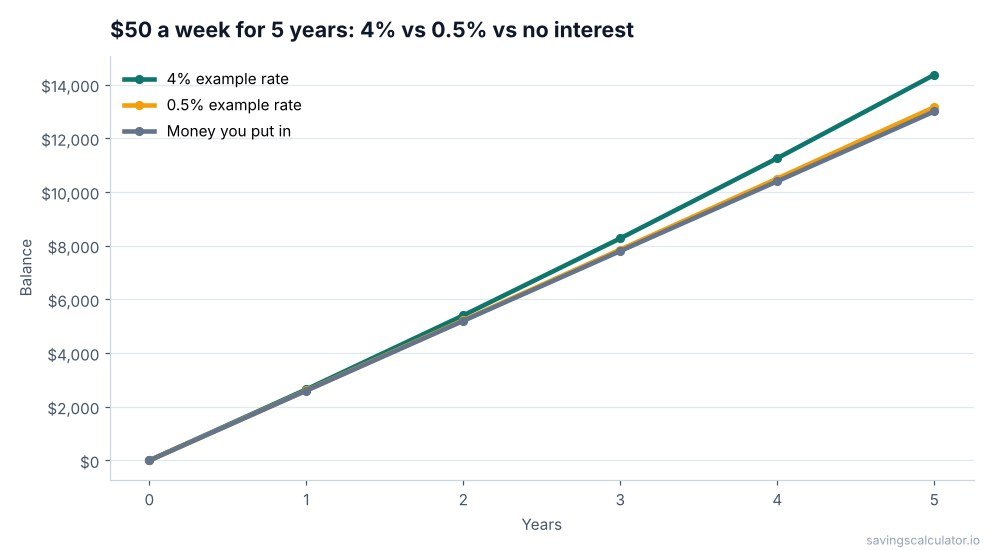
If Maya keeps going for five years at the same rate, she would have about $14,365. She would have put in $13,000 of that herself. The rest, about $1,365, is interest. You can test your own amounts in our savings calculator.
Where should you keep your savings?
Step 3: Open a separate account
Keep your savings apart from your checking account. When the money sits next to your spending money, it is too easy to use. A separate account adds a small speed bump.
Look for these basics in a savings account:
- No monthly fee, or a fee you can avoid easily.
- Low or no minimum to open.
- Insurance. In the US, FDIC insurance covers up to $250,000 per depositor, per bank, per ownership category. Check that the bank is covered.
- A fair interest rate. Compare the APY, which is the yearly rate after compounding. See what APY means for a quick explanation.
Rates change often, so check current offers when you open. Do not pick an account only for its rate. A slightly lower rate with no fees and an easy app can serve a beginner better.
Why the rate matters, even for small amounts
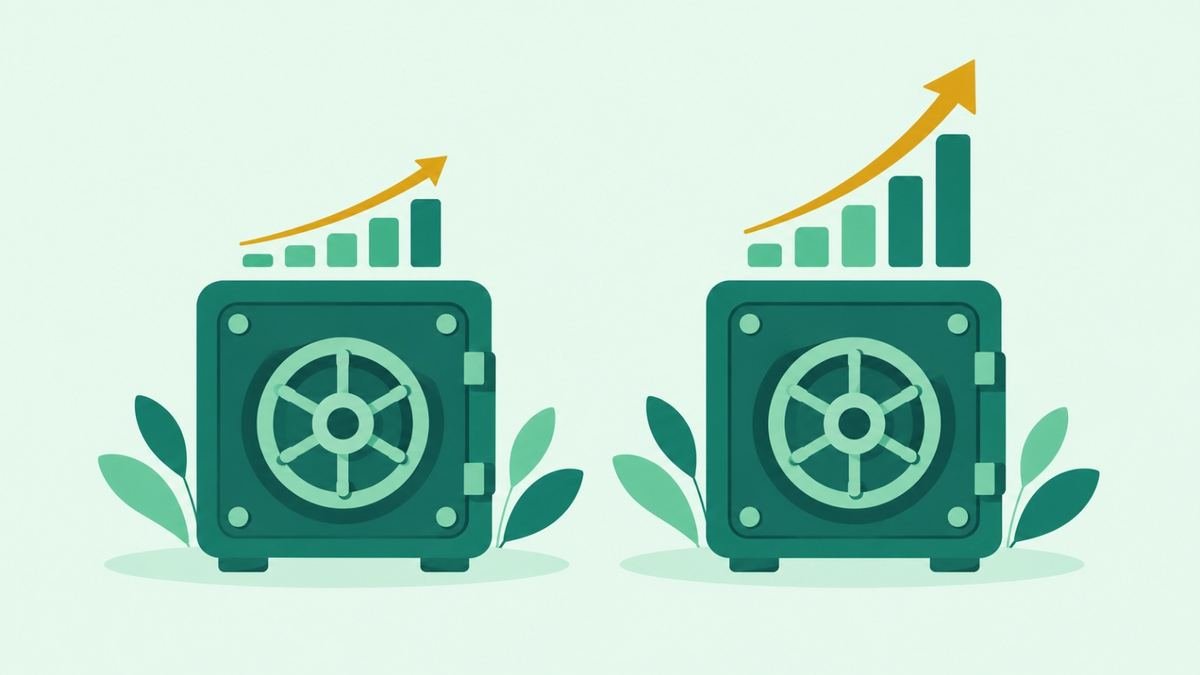
Take the same $50 a week. At an example rate of 0.5%, five years gives about $13,161. At 4%, it gives about $14,365. That is about $1,204 more for the same effort. The chart below shows the gap.
How do you make saving automatic?
Step 4: Automate the transfer
Automation is the most powerful habit step. You set up a repeating transfer once, and your bank does the rest. You never have to decide again.
Follow these small steps:
- Open your bank app and find "transfers" or "recurring transfers".
- Choose your checking account as the source.
- Choose your new savings account as the destination.
- Set the amount from Step 2.
- Set the date to the day after you get paid.
The date matters. If the money leaves right after payday, you spend what is left. If you wait until the end of the month, there is often nothing left to move.
Weekly or monthly?
Match the transfer to how you are paid. If you get paid every week or two weeks, small frequent transfers feel lighter. If you are paid monthly, one monthly transfer is easier to track. The final amount differs only slightly. Our weekly savings calculator and monthly savings calculator let you compare.
How long does it take to save your first $500?
Step 5: Aim for a first $500
A first goal gives the habit a finish line. $500 is a good one. It is big enough to cover many small surprises, like a car repair or a vet visit. It is small enough to reach in a few months.
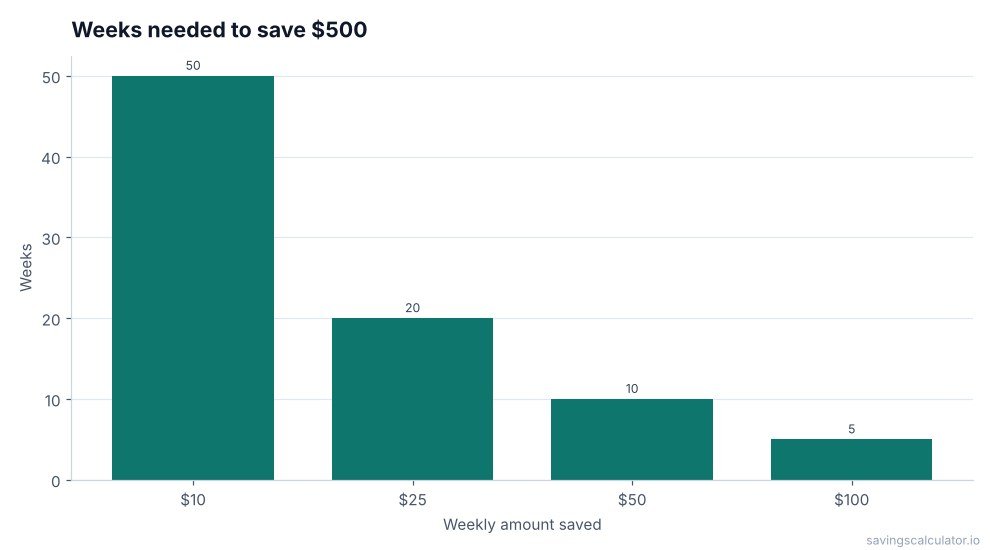
The math is simple. Divide your goal by the amount you save each week.
Step 1: Goal is $500. Weekly savings is $25.
Step 2: $500 ÷ $25 = 20 weeks.
Result: Jordan reaches the goal in 20 weeks, or under five months.
| Weekly amount | Weeks to $500 | Roughly |
|---|---|---|
| $10 | 50 | About 11.5 months |
| $25 | 20 | Under 5 months |
| $50 | 10 | About 2.5 months |
| $100 | 5 | About 1 month |
Once you hit $500, celebrate in a small, cheap way. Then pick the next goal. Many people aim next for one month of expenses, then more. Read how to build an emergency fund for that path.
How do you stop yourself from spending your savings?
Step 6: Protect the money
Saving only works if the money stays put. A few simple habits help.
- Skip the debit card. Do not link your savings account to a card you carry.
- Give the account a name. Many apps let you name it, such as "First $500". A named goal is harder to raid.
- Add a waiting rule. If you want to spend from savings, wait 48 hours first.
- Know what counts as an emergency. A sale is not one. A broken heater in winter is.
It also helps to write down in one sentence why you are saving. Put it where you see it, such as your phone lock screen.
What if you do dip into it?
Then you do. It happens to nearly everyone. Do not scrap the plan. Refill the account as soon as you can, and keep the automatic transfer running.
Think of it this way: savings exist to be used for real needs. If your savings cover a real emergency, they did their job. The goal is to avoid using them for small wants.
Sam has saved $400. A car repair costs $150, so the balance drops to $250. Sam keeps saving $25 a week.
Result: it takes $250 ÷ $25 = 10 more weeks to get back to $500. One setback cost about two months, not the whole habit.
How do you save more over time?
Step 7: Raise the amount a little
Once your first $500 is done, nudge your transfer up. You do not need a big jump. Even a $5 weekly increase every few months makes a real difference.
Good moments to raise it:
- You get a raise or a new job.
- You pay off a bill or a loan.
- You cancel a subscription you do not use.
- Every three months, on a date you set in your calendar.
Set a longer goal too. Our guide to setting a savings goal shows how to pick an amount and a date. Our tips for reaching a goal faster cover more ways to speed up.
See what the extra amount does
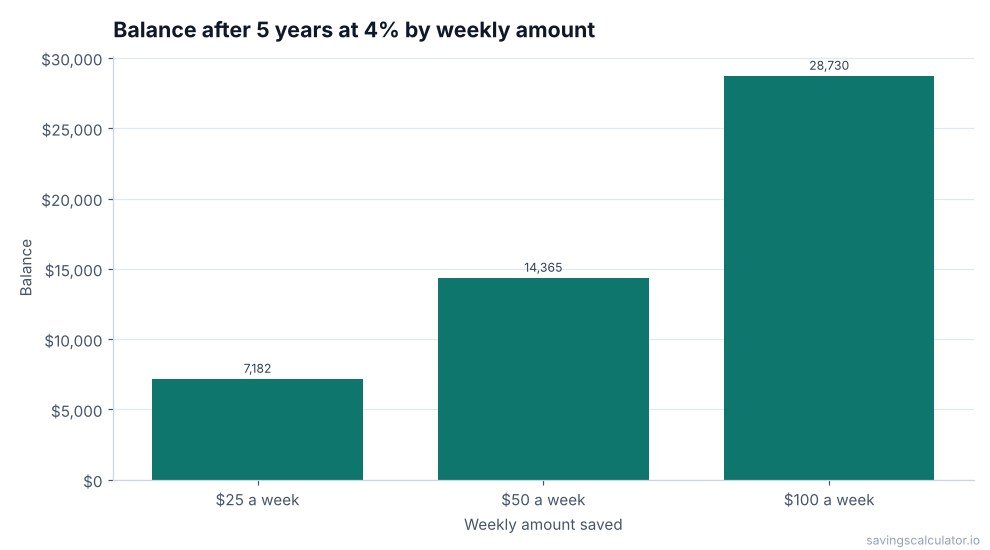
Here is what different weekly amounts could become after five years, using an example 4% rate and monthly compounding.
| Weekly amount | Monthly equivalent | Total put in (5 years) | Balance after 5 years |
|---|---|---|---|
| $25 | about $108 | $6,500 | about $7,182 |
| $50 | about $217 | $13,000 | about $14,365 |
| $100 | about $433 | $26,000 | about $28,730 |
Doubling the weekly amount roughly doubles the result. Small steps up add up fast.
What are the most common mistakes when you start saving?
Most people trip over the same few things. Knowing them in advance makes them easier to avoid.
Mistakes to avoid
- Starting too big. A huge goal burns out fast. Start small and grow.
- Waiting for "extra" money. Extra money rarely shows up. Pay yourself first, then spend what remains.
- Keeping savings in checking. It blends in with daily spending and disappears.
- Chasing the top rate only. Fees, limits and a clunky app can cancel a small rate gain.
- Locking all your money away. At the start, you need easy access. A CD, which locks money for a set time, can come later. See savings account vs CD when you are ready.
- Quitting after one slip. One missed week is not failure. Just restart the transfer.
- Never checking in. Look at your balance once a month, and raise the amount when you can.
None of these mistakes are permanent. Each one can be fixed in a single evening.
What should you do next?
You now have the plan. Here is a short checklist for this week:
- Look at your last 30 days of spending.
- Choose a weekly or monthly amount, even if it is only $10.
- Open a separate savings account with no monthly fee.
- Set up the automatic transfer for the day after payday.
- Name the goal "First $500".
Then use the savings calculator to see how your amount could grow. Try a few amounts and a few rates. Seeing the numbers makes the goal feel real.
Come back every three months. If you can, raise the amount a little. In a year, you could have a real cushion, and a habit that keeps working for you. That is a strong start.
Put your own numbers into our free Savings Calculator. No signup. Works on any phone.
Frequently asked questions
How much money should I save when I first start?
Start with whatever you can keep up, often 1% to 5% of your take-home pay. Even $10 a week builds the habit. You can raise it later. Our savings calculator shows how different amounts could grow over time.
What is the easiest way to start saving money?
Set up an automatic transfer from checking to a separate savings account on the day after payday. Once it is automatic, you do not need willpower. Start small, name the account after a goal, and raise the amount every few months.
How can I save money on a low income?
Start with a very small amount, such as $5 a week, and keep the habit going. Look for one or two costs to trim. Raise your transfer whenever a bill ends or your pay rises. Our guide on building an emergency fund has more ideas.
Should I save money or pay off debt first?
It depends on your debt and its interest rate. Many people build a small starter fund, like $500, so a surprise bill does not push them back into debt. Then they focus on high-interest debt. Check your own numbers and current rules before you decide.
How long does it take to save $1,000?
Divide $1,000 by your weekly amount. At $50 a week, it takes 20 weeks. At $25 a week, it takes 40 weeks. Interest adds a little at this size. Use the savings goal calculator to test your own timeline.
Where should I keep my savings as a beginner?
A separate savings account at an insured bank is a simple choice. Look for no monthly fee, a low minimum and a fair rate. In the US, FDIC insurance covers up to $250,000 per depositor, per bank, per ownership category. Check that your bank is covered.
Is it okay to start saving with just $10?
Yes. Ten dollars a week is $520 in a year, before interest. The habit matters more than the amount at first. Once it feels normal, raise the transfer a little at a time.
How often should I check my savings?
Once a month is enough for most people. Look at the balance, check that the transfer ran, and decide if you can raise the amount. Checking daily can tempt you to spend or make you feel discouraged.
Please note: This guide is for education only and is not personal financial advice. Numbers in examples are simple estimates, not promises. Rates, fees and rules change, so check with your bank or a qualified adviser before you decide. See our disclaimer.