Savings Account vs CD in 2027: Which Is Better? (Free Online CD Calculator)
Should your money sit in a savings account or a certificate of deposit (CD)? This free 2027 guide explains what each is, why the choice matters, how to decide, when each makes sense, and the good and bad of both. You can estimate results with our free online CD calculator.
Free online tool: use our free CD Calculator. No signup, works on any phone.
What is a savings account, and what is a CD?
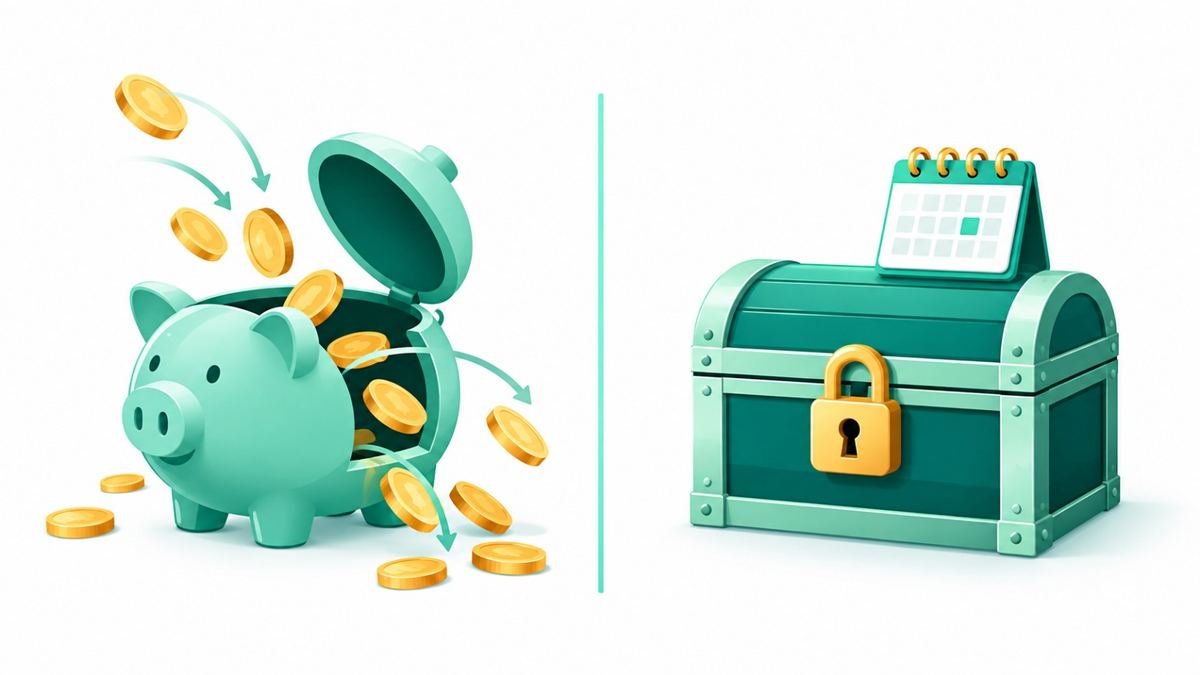
A savings account holds your money and pays interest, usually at a variable rate, while letting you add or withdraw funds. Some providers limit the number of withdrawals or require a minimum balance.
A certificate of deposit (CD) is a deposit for a fixed term, such as six months or five years. In return for leaving the money in place, you typically get a fixed rate. Withdrawing early usually costs a penalty. Names and rules differ by country, so read the terms of any product you consider.
Why does the choice matter?
The choice affects three things: how much you earn, how easily you can reach your money, and how exposed you are to changing interest rates. Picking the wrong one can mean paying a penalty when you need cash, or earning less than you could have on money you did not need soon.
An illustration: $10,000 for five years. In a CD at 4.5% APY, it grows to about $12,462. In a savings account averaging 3% it would reach about $11,593, and at 5% about $12,763. The CD gives certainty; the savings account gives flexibility, and its result depends on where rates go. These are examples, not forecasts.
Savings account vs CD: main differences
- Access: savings is flexible; a CD is locked until maturity.
- Rate: savings is usually variable; a CD is often fixed for the term.
- Deposits: savings usually allows ongoing deposits; a CD is normally one lump sum.
- Penalties: savings rarely has them; a CD often does.
- Predictability: a CD tells you the end result on day one.
How does an early withdrawal penalty work?
Penalties are often expressed as a number of days or months of interest. For example, a penalty equal to 90 days of interest on $10,000 at 4.5% would be roughly $111. In some cases a penalty can be larger than the interest earned so far, which could reduce your original deposit. Always check the exact terms.
When does a savings account make sense?
A savings account tends to suit money you may need at short notice, such as an emergency fund, or money you plan to keep adding to. It also suits situations where you expect rates to rise, since a variable rate can rise with them, though nobody can predict rates with certainty.
When does a CD make sense?
A CD tends to suit money you will not need until a known date, such as a tuition payment or a planned purchase. It can also appeal when you want a fixed rate in case rates fall. Some people build a ladder, splitting money across CDs that mature at different times, so part becomes available regularly.
Good or bad: the honest trade-offs
Savings account, the good: access, simplicity, and the ability to add money anytime. The bad: the rate can fall, and easy access can make it tempting to spend.
CD, the good: a predictable return and a built-in discipline not to touch the money. The bad: penalties, and the risk that rates rise while your money is locked in at a lower fixed rate.
Neither is better in every case. The right mix depends on your time frame and your need for access.
How to choose in five steps
- Decide how soon you might need the money.
- Keep emergency money accessible.
- Match money with a known future date to a term that ends before you need it.
- Compare current APYs, fees and penalties from providers you trust, and check how deposits are protected. In the US, insured deposits are generally covered up to $250,000 per depositor, per institution, per ownership category; other countries have their own rules.
- Estimate results with the CD and savings calculators.
When you know only the APY, set “Rate type” to APY in our calculators so the result matches.
Common mistakes
- Locking emergency money in a CD.
- Ignoring the renewal terms; some CDs renew automatically.
- Comparing rates without comparing penalties.
- Assuming a savings rate will stay where it is.
A simple CD ladder example
One way to blend the two approaches is a CD ladder: split money across CDs with different terms so some matures every year. For example, splitting $10,000 into four $2,500 CDs at 1, 2, 3 and 4 years, at rates of 4.0%, 4.2%, 4.4% and 4.6%, gives roughly $2,600, $2,714, $2,845 and $2,993 at each maturity, a total of about $11,152.
Compare that with putting the full $10,000 into a single 4-year CD at 4.6%, which would reach about $11,971. The ladder earns somewhat less overall because three of the four portions are locked at shorter terms with lower rates, but in exchange, part of the money becomes available every year without triggering an early withdrawal penalty. Laddering is a trade-off between return and access, not a way to beat a single higher rate.
Deposit protection: a factor beyond the rate
Whichever you choose, check how deposits are protected. In the US, insured deposits at a covered bank or credit union are generally protected up to $250,000 per depositor, per institution, per ownership category. Other countries have their own deposit protection schemes and limits. This protection applies in the same way to savings accounts and CDs at an insured institution, so it should not be the deciding factor between the two, but it is worth confirming for any new provider.
Frequently asked questions
Is a CD better than a savings account?
Neither is always better. A CD offers a predictable fixed return for a set term; a savings account offers access and flexibility.
What happens if I withdraw from a CD early?
Many CDs charge a penalty, often expressed as days or months of interest. Check the terms before opening one.
Can I add money to a CD?
Usually not after opening, though some providers offer add-on CDs. Check the terms.
Is there a free CD calculator online?
Yes. Our CD calculator is free, needs no signup and shows your final balance and interest.
Is my money safe in a CD or savings account?
Protection depends on the provider and country. In the US, insured deposits are generally covered up to $250,000 per depositor, per institution, per ownership category.
What is a CD ladder?
Splitting money across CDs with different terms so a portion matures regularly, balancing return with periodic access to funds.
Does laddering earn more than a single long CD?
Usually somewhat less overall, since only the longest portion gets the highest rate; the benefit is more frequent access rather than a higher total return.
Try these free calculators
CD Calculator
Estimate a certificate of deposit balance at maturity.
Calculate Now →High-Yield Savings Calculator
Compare two APYs that you enter yourself.
Calculate Now →