CD Calculator 2027: Free Online Tool
Estimate a certificate of deposit balance at maturity.
Use the free CD calculator above to estimate what a certificate of deposit will be worth at maturity, based on the APY and term your bank has quoted. A CD locks your money away for a fixed period in exchange for a set rate, so knowing the exact maturity value in advance helps you compare it with other options before committing.
Below, we cover the formula, a full worked example including an early-withdrawal penalty estimate, and the details people most often overlook when comparing CD offers.
Formula and assumptions
Uses the compound formula; a quoted APY is converted to the equivalent periodic rate first. Actual CD terms, penalties and withdrawal rules vary by institution.
Estimates only. Actual growth can differ because rates may change, taxes may apply, and institutions may calculate interest differently.
What Is a CD Calculator?
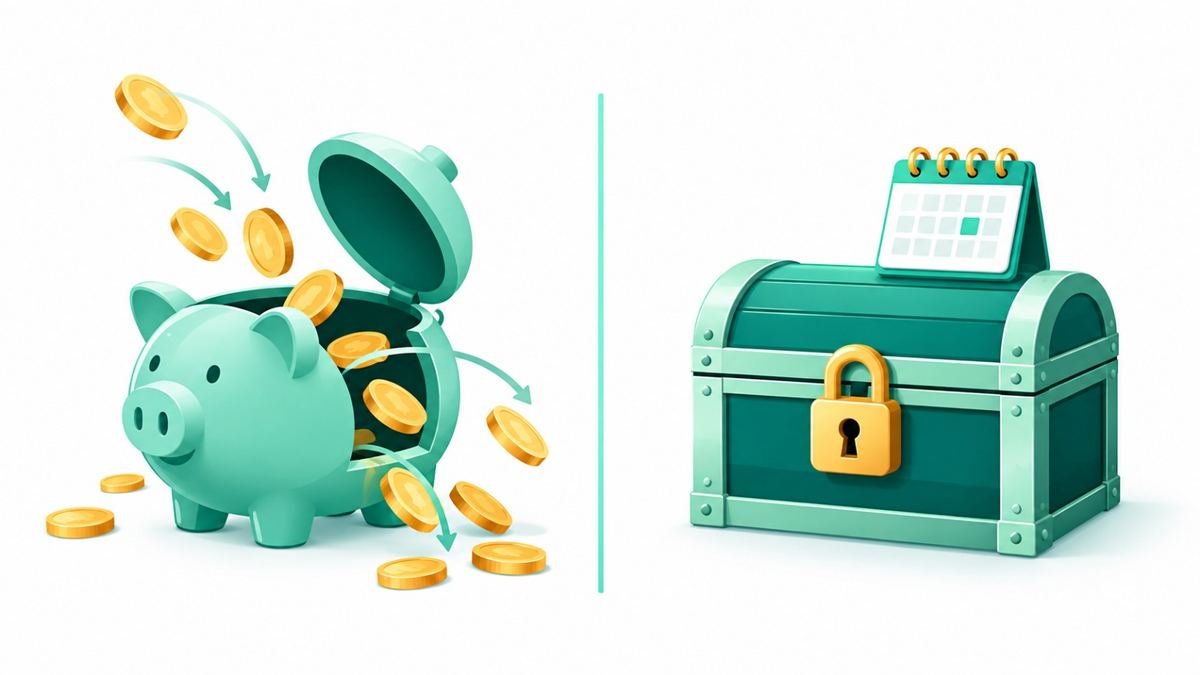
A CD calculator projects the maturity value of a certificate of deposit (CD): a fixed-term deposit that pays a set interest rate in exchange for leaving your money untouched until the term ends. Because the rate and term are usually fixed from the start, a CD's future value can be calculated precisely — unlike a variable-rate savings account, which can only be estimated.
How Does This CD Calculator Work?
You enter your initial deposit, the APY (or plain rate) your bank has quoted, the term in years, and the compounding frequency stated in the CD's terms. If your CD allows additional deposits (uncommon, but some do), you can include a regular contribution too. The calculator then projects the exact balance at maturity using standard compound interest.
CD Calculator Formula
Maturity value = P × (1 + r/n)nt
- P = your initial deposit
- r = the interest rate (converted from APY first, if that is what you were quoted)
- n = the compounding frequency
- t = the term in years
If you were quoted an APY rather than a plain rate, the calculator converts it first using r = n × ((1 + APY)1/n − 1), so the result matches what your bank actually advertises.
How to Use the CD Calculator
- Enter your initial deposit.
- Enter the rate, switching "Rate type" to APY if that is what was quoted.
- Enter the term in years and the compounding frequency from your CD's terms.
- Add any additional deposits, if your specific CD allows them.
- Read your result: maturity value and total interest earned.
CD Calculator Example
$10,000 at 4.75% APY, monthly compounding, for a 3-year term:
| Input | Value |
|---|---|
| Initial deposit | $10,000 |
| APY | 4.75% |
| Term | 3 years |
Result: the CD matures at about $11,494 — $1,494 of interest over the 3-year term. For a 1-year term at the same rate, the balance would reach about $10,475.
Early withdrawal penalty illustration: many CDs charge a penalty equal to a number of days of interest for withdrawing early. On this CD, a penalty of 90 days' interest would be roughly $117 — worth knowing before you commit funds you might need sooner.
A smaller example: $2,000 at 4% APY for a 2-year term grows to about $2,163 — $163 of interest.
Why Use This CD Calculator?
- It gives an exact, not estimated, result — since a CD's rate is fixed for the term, the maturity value can be calculated precisely rather than projected.
- It lets you compare CD offers directly against each other or against a high-yield savings account using the High-Yield Savings Calculator.
- It helps you weigh the early withdrawal penalty against the benefit of locking in a rate, before you commit funds.
When Should You Use a CD Calculator?
- You have money you will not need until a specific future date, and a CD's fixed term matches that timeline.
- You are comparing a CD against a savings account to see whether the CD's typically higher rate is worth the reduced access.
- You are building a CD ladder — splitting money across CDs with different terms — and want to project each one individually before adding them up.
What Does the Result Mean?
Maturity value is the exact balance your CD will reach if held for the full term without withdrawal. Interest earned is the difference between that and your initial deposit. Because CD rates are typically fixed, this projection is usually far more reliable than a savings account projection, which assumes a rate that could change.
Common Mistakes When Using a CD Calculator
- Not accounting for the early withdrawal penalty when comparing a CD against a more flexible option.
- Assuming a CD auto-renews at the same rate. Many CDs roll over into a new term automatically at whatever rate is current at that time, which could be lower.
- Locking away money you might actually need before the term ends, forcing an early withdrawal and its penalty.
- Confusing the CD's APY with a plain interest rate when entering it — use "Rate type" to specify which one you have.
Tips for Using CDs Effectively
- Only commit money you are confident you will not need before the term ends.
- Check the renewal terms before the CD matures, since automatic renewal may not offer the best available rate.
- Consider a CD ladder — splitting funds across CDs with staggered terms — to balance the higher rates of longer terms with more frequent access to part of your money.
- Compare the CD's APY against a high-yield savings account before committing, since the gap is not always as large as it first appears.
Related Financial Concepts
- APY — the yearly return including compounding, which CDs are usually quoted in; see the APY Calculator.
- Early withdrawal penalty — a fee for accessing CD funds before the term ends, often expressed as a number of days or months of interest.
- CD ladder — a strategy of splitting savings across multiple CDs with different maturity dates to balance rate and access.
- High-yield savings account — a more flexible alternative; compare using the High-Yield Savings Calculator.
Frequently asked questions
Is this CD calculator free?
Yes, completely free with no signup required.
How much will a $10,000 CD earn?
It depends on the rate and term. As an example, $10,000 at 4.75% APY for a 3-year term matures at about $11,494 — $1,494 of interest.
Can I add money to a CD after opening it?
Usually not, though some providers offer add-on CDs that allow additional deposits. Check your specific provider's terms.
What happens if I withdraw from a CD early?
Most CDs charge an early withdrawal penalty, often equal to a set number of days or months of interest, which can reduce the interest you have earned.
Should I enter APY or interest rate for a CD?
Either — use the "Rate type" setting to match what your CD actually quotes, since most CDs advertise APY directly.
Do CDs automatically renew?
Many do, rolling into a new term at the then-current rate unless you withdraw or redirect the funds during a grace period — check your provider's renewal notice.
Is my money safe in a CD?
At an insured institution, CD deposits are typically protected up to your country's deposit insurance limit — confirm this with your specific provider.
What is a CD ladder?
A strategy of splitting money across several CDs with different terms, so a portion matures periodically, balancing the higher rates of longer terms with more regular access to funds.
Is a CD better than a high-yield savings account?
Neither is universally better — a CD typically offers a fixed rate for reduced access, while a savings account offers more flexibility with a usually variable rate. Compare both using their respective calculators.
Does this calculator include the early withdrawal penalty automatically?
No, the main projection assumes you hold the CD for its full term. Use the penalty estimate in the example above as a guide for what an early withdrawal might cost.
Guides for this calculator

Related calculators
Inflation Savings Calculator
Estimate how inflation could change purchasing power.
Calculate Now →College Savings Calculator
Compare projected savings with an inflation-adjusted college cost.
Calculate Now →Vacation Savings Calculator
Work out the monthly amount needed for your trip.
Calculate Now →Down Payment Savings Calculator
Track progress toward a down payment target.
Calculate Now →