How to Save Money on a Low Income: 9 Practical Steps
To save money on a low income, start with a very small weekly amount, such as $10. Move it to a separate account on payday so you do not spend it. Then cut a few small leaks, add a little extra income, and raise your amount every few months. Small steps add up faster than most people expect.
- You do not need a big income to save. You need a small amount and a steady habit.
- Start with an amount that feels almost too small, like $10 a week. You can raise it later.
- Saving $520 in a year is a real win. At an example 4% rate, $10 a week grows to about $2,877 in 5 years.
- Track your spending for 30 days. You will find money you did not know you had.
- Pay yourself on payday, before bills and fun spending eat the money.
- Keep a first goal of $500 for surprises, so one bad week does not undo your progress.
Saving money is hard when every dollar already has a job. Rent, food, transport and bills come first, and there is often nothing left at the end of the month. If that sounds like your life, you are not doing anything wrong. Many people feel the same way.
The good news is that saving on a low income is still possible. It just works a little differently. You do not look for a big number. You look for a small, steady number that you can keep up even in a bad month.
In this guide, we use simple words and real numbers. You will see nine steps you can follow today, a table of small savings and what they grow into, and a 90-day plan to get you going. Every example is easy to check with our free calculators.
What does saving on a low income really mean?
A low income does not have one fixed number. It depends on where you live, how many people you support and what your bills cost. A better way to think about it is this: low income means your essential bills use most of your pay.
When most of your pay is already spoken for, advice like "save 20% of your income" can feel unfair. It may not be possible right now. That is okay.
On a low income, the goal changes. You are not trying to match a rule. You are trying to build the habit of saving and a small safety cushion. The habit matters more than the amount at the start.
Here is a simple way to measure your progress. It is called your savings rate.
Let us use an example. Maya takes home $1,900 a month. She saves $10 each week. A month has about 4.33 weeks, so that is roughly $43 a month. Her savings rate is $43 ÷ $1,900, which is about 2.3%.
That is small. But it is a real start, and Maya can raise it step by step. If you want to see how this compares with common guidelines, read our guide on how much you should save each month.
Tip: Do not compare your savings with other people. Your only job is to save a little more than you did last month.
Step 1: Pick a starting amount that feels almost too small
Most people fail at saving because they start too big. They promise $300 a month, miss it in week two and give up. A tiny amount is much easier to keep.
Pick a number that you will hardly notice. For many people, that is $5 to $25 a week. Choose the amount, not the feeling. A small amount that you save every week beats a big amount that you save once.
Here is what a few small weekly amounts can become. The table assumes an example interest rate of 4% a year and deposits every week.
| Weekly saving | You put in (1 year) | Total after 1 year | Total after 3 years | Total after 5 years |
|---|---|---|---|---|
| $10 | $520 | $530 | $1,657 | $2,877 |
| $25 | $1,300 | $1,326 | $4,142 | $7,192 |
| $50 | $2,600 | $2,652 | $8,283 | $14,383 |
The numbers are not huge, but look at the $25 row. After five years, you would have about $7,192. Of that, $6,500 is your own money and the rest is interest. That could cover a car repair, a security deposit or a few months of rent in a hard time.
You can test your own amount with our Weekly Savings Calculator.
Step 2: Learn where your money goes now
You cannot save what you cannot see. Many people on tight budgets are surprised to find small amounts leaving their account that they did not plan for.
For the next 30 days, write down everything you spend. You can use a notebook, a notes app or your bank app. Do not try to change anything yet. You are only collecting facts.
At the end of the month, sort your spending into three groups:
- Must-pay bills: rent, utilities, transport, minimum debt payments, basic food.
- Flexible needs: groceries beyond the basics, phone data, medicine, school costs.
- Wants: takeout, apps, games, subscriptions, shopping.
Add up each group. Then look at the third group first. Even on a tight budget, this group often hides $30 to $100 a month that you can redirect without hurting your life.
If you want a full walk-through of this process, our guide on how to create a monthly budget shows it step by step with a worked example.
Step 3: Cut the small leaks, not your whole life
Cutting everything fun is a plan that does not last. A better idea is to find leaks. A leak is a cost that gives you little value, such as a service you forgot you pay for.
Here are five common leaks, with example monthly savings. Your numbers will be different, so use this as a checklist.
| Common leak | What to do | Example saving per month |
|---|---|---|
| Unused subscriptions | Cancel apps and streaming you have not used in 30 days | $18 |
| Phone plan | Move to a cheaper plan or a prepaid plan | $15 |
| Takeout | Cook two more meals at home each week | $30 |
| Bank fees | Switch to an account with no monthly fee | $8 |
| Groceries | Use a list and store brands | $25 |
| Total | $96 |
In this example, the total is $96 a month, which is $1,152 a year. And nobody had to give up their home or their phone.
Watch out: Do not cut things that protect you, like health insurance, basic car insurance or medicine. Saving $20 a month on a policy is not worth a big bill later.
Step 4: Pay yourself on payday
If you wait until the end of the month to save "what is left," there is usually nothing left. The fix is simple. Save first, spend the rest.
On payday, move your small amount to savings before you pay for anything else. This idea is often called "pay yourself first." It works because you do not need to find willpower every week. The decision is already made.
Let us see what a difference this makes. Say Maya plans to save $40 a month. Without a payday rule, she saves in only about half of the months, because other costs get in the way. With a payday rule, she saves every month.
| Method | Months saved in a year | Amount saved in a year |
|---|---|---|
| Save what is left | 6 | $240 |
| Pay yourself first | 12 | $480 |
The amount is the same each time, but the habit is very different. The payday rule saves $240 more in one year, just by changing the order of steps.
If your pay comes in more than once a month, split the amount. For example, save $10 from each of four weekly paychecks.
Step 5: Keep your savings in a separate account
Money that sits in your main account is easy to spend. Money in a separate account is harder to touch. That small bit of friction protects your savings.
Look for a savings account with these features:
- No monthly fee, or a fee you can avoid easily.
- A very low or zero minimum balance, so small deposits are welcome.
- A fair interest rate. Online accounts often pay more than a basic branch account. Our guide on what APY means explains how to compare rates.
- Deposit protection. In the United States, look for FDIC or NCUA insurance. Check the rules for your own country if you live elsewhere.
Give the account a name that reminds you why you are saving, such as "Car repair" or "First $500." A clear name makes it easier to leave the money alone.
If you can, set up an automatic transfer on payday. Many banks let you do this in a few minutes inside the app.
Step 6: Use found money the smart way
"Found money" is cash you did not expect. It might be a tax refund, a small gift, a refund for a returned item or money from selling something you no longer use.
Most people spend found money fast because it feels free. A simple rule can help: save half, enjoy half. You still get a treat, and your savings still grow.
For example, say you sell old furniture for $80. You put $40 into savings and use $40 for something nice. Do this a few times a year and you may add $200 or more without touching your regular budget.
Example: Maya gets a $120 refund from her utility company. She saves $60 and spends $60 on groceries and a small treat. Her savings jump by $60 that month, and she does not need to change her normal budget at all.
This method works well for people who feel that saving is a punishment. You are not giving up fun. You are splitting it.
Put your own numbers into our free Monthly Savings Calculator. No signup. Works on any phone.
Step 7: Earn a little more
Cutting costs only goes so far. Sooner or later, adding a bit of income helps more than cutting another $5. You do not need a second full-time job. Even a few extra hours can matter.
Ideas to think about, depending on your skills and time:
- Sell items you no longer use.
- Do a short weekly gig, such as tutoring, delivery or pet sitting.
- Ask for more hours at your current job.
- Offer a skill, like cleaning, repairs, writing or design.
- Check for help you may qualify for, such as local assistance programs or tax credits.
Here is a simple way to turn extra income into savings. Decide on a rule before the money arrives. For example, "I will save 50% of anything I earn on the side."
If Maya earns $120 a month from a side job and saves half, she adds $60 a month. Over a year, that is $720.
Step 8: Build a small $500 buffer first
A surprise bill is the biggest danger to a low-income saver. A broken phone, a flat tire or a missed shift can wipe out weeks of progress. When that happens, many people give up on saving.
That is why your first goal should be a small buffer. Many people start with $500. It will not cover a huge emergency, but it can cover many common ones.
At $25 a week, how long does it take to reach $500? You can use this formula, ignoring interest for a simple estimate:
So it takes about 20 weeks, which is under five months. At $10 a week, it takes 50 weeks, or about one year. Both plans work. The second one is just slower.
Once you reach your first $500, keep going toward a bigger cushion. Our guide on how to build an emergency fund explains how many months of costs to aim for, and our Savings Goal Calculator can show how long your plan will take.
Step 9: Raise your amount a little every few months
Your income and your costs will change over time. Use those changes to your advantage. Every time something improves, move a small part of it to savings.
Here are good moments to raise your amount:
- You get a pay raise.
- You pay off a loan or a bill.
- A subscription or plan gets cheaper.
- You finish a short-term cost, like a class.
Try this rule: increase your savings by $5 or $10 a week every three months. The change is small, so it is easy to live with. But it adds up.
For example, start at $10 a week. After three months, move to $15. After another three months, move to $20. In one year, you will be saving $25 a week without any shock to your budget.
Tip: When you get a raise, move half of it to savings. You still enjoy a higher income, and your savings rate goes up for free.
What do small savings grow into?
Let us look at the whole picture. The chart below compares three small weekly amounts over five years, using the same example 4% rate as before.
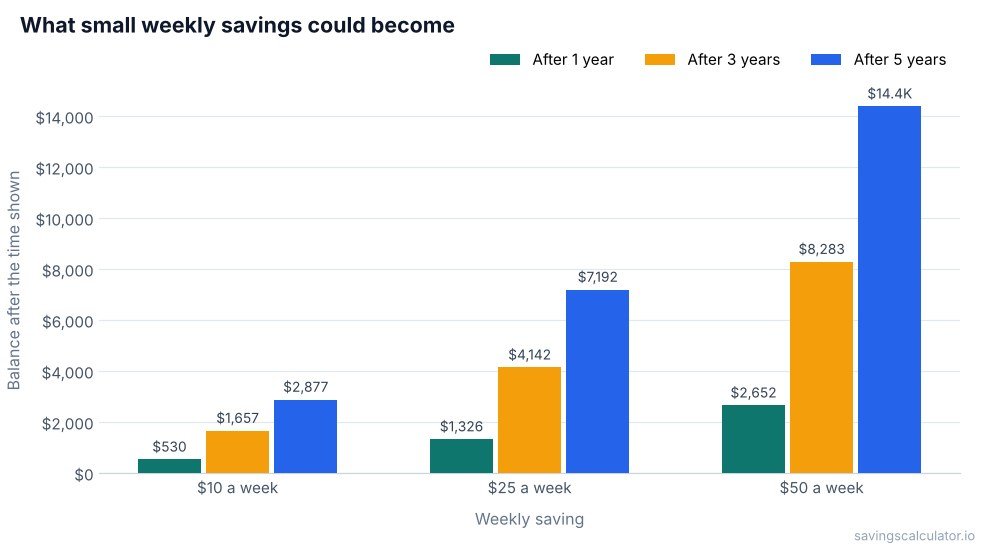
The chart shows that time is your best helper. Doubling the weekly amount doubles the result. But staying with the plan for five years instead of one multiplies it by more than five, because interest begins to earn its own interest.
The next chart shows the same idea for a $25 weekly plan. It compares keeping the money in a savings account with keeping it as cash and earning nothing.
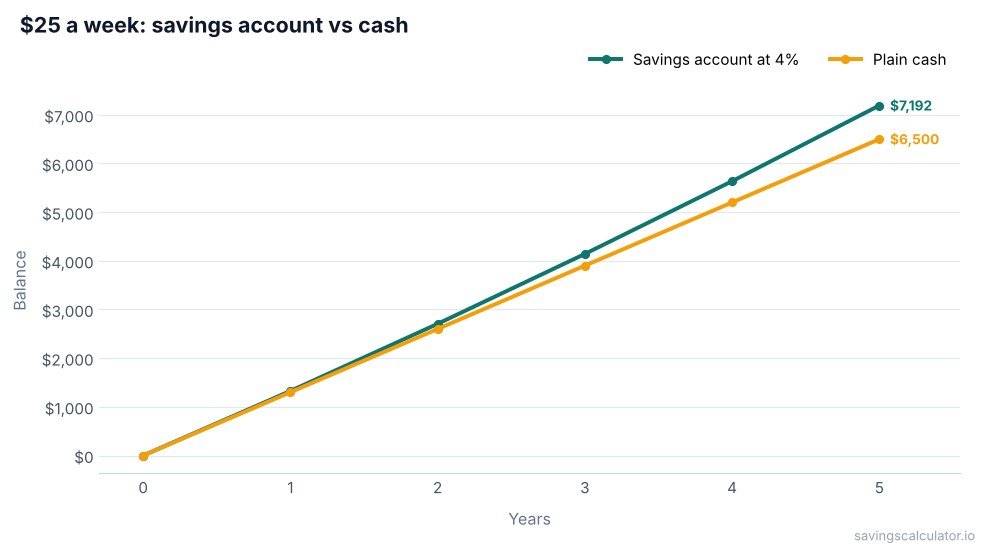
After five years, the account holds about $7,192, while plain cash holds $6,500. That is $692 of extra money for doing nothing more than choosing an account that pays interest.
Remember that these are examples. Real rates change, and some accounts pay less than 4% while others pay more. To test your own numbers, open the Monthly Savings Calculator and type in your amount, rate and time.
What are the most common mistakes to avoid?
Even with a good plan, a few mistakes show up again and again. Here are the ones to watch for.
- Starting too big. A plan you cannot keep is worse than a small plan you can. Start with an amount you can repeat even in a bad month.
- Giving up after one miss. Missing a week is normal. Do not quit. Just save again the next week.
- Leaving savings in your spending account. If you can see it, you will spend it. Move it away.
- Using high-cost credit for small gaps. Payday loans and some credit cards can cost far more than savings can earn. A small buffer protects you from them.
- Ignoring fees. A $5 monthly fee on a small balance can eat more than the interest you earn. Pick a no-fee account.
- Saving without a goal. A name like "First $500" or "Car repair" keeps you motivated.
If you are not sure where to begin, our guide on how to start saving money has a seven-step plan for beginners.
A simple 90-day plan to get started
You do not need to do everything at once. Here is a gentle plan for the next three months.
Days 1 to 7: Choose a weekly amount between $5 and $25. Open a separate savings account with no monthly fee. Name it after your first goal.
Days 8 to 30: Track every expense in a notebook or app. Set up an automatic transfer on payday. Make your first deposit.
Days 31 to 60: Review your month. Find three small leaks and cut them. Send the money you free up to savings.
Days 61 to 90: Raise your weekly amount by $5. Add one small way to earn, such as selling an unused item. Check how close you are to your first $500.
At the end of 90 days, you will have a working system. The amount may still be small. But you will have proof that you can do it, and that is the hardest part.
What should you do next?
Saving on a low income is a slow game, and that is fine. You win by staying in it. Here are three actions you can take today:
- Pick your weekly amount. Even $5 counts.
- Open or name a separate savings account. Make it easy to leave alone.
- Set a reminder or automatic transfer for your next payday.
Then use the free Monthly Savings Calculator to see where your plan could be in one, three and five years. Seeing the numbers on screen often makes it easier to keep going.
Frequently asked questions
How much should I save if I have a low income?
Start with an amount that feels almost too small, such as $5 to $25 a week. The right number is the one you can keep up in a bad month. After a few months, raise it by a few dollars. Many people aim for 10% to 20% of take-home pay over time, but that is a long-term goal, not a day-one rule.
Is it worth saving small amounts?
Yes. Small amounts build the habit, and the habit matters most. In our example, $25 a week grew to about $7,192 in five years at a 4% rate. That is enough to cover many surprise costs without borrowing.
Where should I keep my savings if I earn very little?
Use a separate savings account with no monthly fee and a low or zero minimum balance. Online accounts often pay higher rates. In the United States, check that the bank is FDIC insured or the credit union is NCUA insured.
Should I save or pay off debt first?
It depends on the interest rate on your debt. Many people build a small buffer of about $500 first, so a surprise bill does not push them into more debt. After that, they pay down high-interest debt while still saving a little. This guide is general, so check your own situation with a trusted adviser if you are unsure.
How can I save money when my bills use all of my pay?
Look at the cost side and the income side. Track spending for 30 days, find small leaks like unused subscriptions, and look for one small way to earn extra. Even $20 to $40 a month is a good start. Also check whether you qualify for any local help or tax credits.
What if I miss a week of saving?
Do not worry. Just save again next week. One missed deposit does not ruin your plan. The danger is quitting. If you miss often, lower your weekly amount so it fits your real life.
How long does it take to save $500 on a low income?
At $25 a week, it takes about 20 weeks, or under five months. At $10 a week, it takes about 50 weeks. You can use the Savings Goal Calculator to test other amounts and see the date you will reach your goal.
Do I need a budget to save money?
A simple budget helps because it shows where your money goes. It does not need to be complex. A list of your income, your must-pay bills and one savings amount is enough to start. You can add more detail later.
Please note: This guide is for education only and is not personal financial, tax or legal advice. Numbers in examples are simple estimates, not promises. Rates, fees and rules change, so check with your bank or a qualified adviser before you decide. See our disclaimer.
Keep reading
Related calculators
Monthly Savings Calculator
Project future savings from a fixed monthly contribution.
Calculate Now →Weekly Savings Calculator
Project future savings from weekly contributions.
Calculate Now →Savings Goal Calculator
Find out how much to save to reach a target, or how long a set contribution will take.
Calculate Now →Daily Savings Calculator
See what small daily contributions can add up to.
Calculate Now →