Rule of 72 Explained: How Fast Will Your Money Double?
Have you ever wondered how long it would take your savings to double? You do not need a calculator for a rough answer. The rule of 72 gives you one in about five seconds, using only division.
This guide shows how the rule of 72 works, where it comes from, and how close it is to the exact answer. We use plain words and small numbers you can check by hand. All rates are examples, not promises. By the end, you will know how to use the shortcut in your head and when to switch to a real compound interest calculator.
The rule of 72 is a quick shortcut to estimate how long money takes to double. Divide 72 by the yearly interest rate. At 6%, 72 ÷ 6 gives about 12 years. It works best for rates between 4% and 12%. For exact answers, use a compound interest calculator.
- The formula is Years to double = 72 ÷ rate. At 4% that is 18 years.
- At 8%, money doubles in about 9 years. At 2%, it takes about 36 years.
- The rule is a shortcut, not an exact answer. It is closest at rates from 6% to 10%.
- Doubling works twice: at 6%, $10,000 becomes about $20,122 in 12 years and $40,489 in 24 years.
- You can also use it for inflation: at 3% inflation, prices double in about 24 years.
- Rate matters, but so does time. Starting early gives you more doublings.
What is the rule of 72?
The rule of 72 is a mental shortcut. It tells you roughly how many years it takes for money to double when it earns a steady yearly rate with compound interest. Compound interest means you earn interest on your old interest too. If that idea is new, our guide on how compound interest works explains it step by step.
Here is the formula.
That is all. Let us try it with a few rates.
- At 3%, 72 ÷ 3 = 24 years.
- At 6%, 72 ÷ 6 = 12 years.
- At 9%, 72 ÷ 9 = 8 years.
Notice the pattern. When the rate goes up, the doubling time goes down. A higher rate means each year adds more, so the pile grows faster.
How do you use the rule of 72 step by step?
You can use the rule in two directions. You can find the time, or you can find the rate you need.
Finding the time to double
Divide 72 by the rate. That is the number of years.
Example: Leo's savings
Leo has $5,000 in an account that earns an example rate of 4% a year. How long until he has about $10,000?
72 ÷ 4 = 18 years. The exact answer is about 17.7 years, so the shortcut is very close.
Finding the rate you need
Turn the formula around. Divide 72 by the years you have.
Example: Ana's goal
Ana wants to double her money in 6 years. She needs about 72 ÷ 6 = 12% a year. That is a very high rate for a savings account, so she may need to save more each month or give herself more time.
This second use is a good reality check. If a plan needs a rate that sounds too high, the plan is probably too hopeful. A bank savings account will not double your money in six years, and nobody can promise that any other option will either.
How accurate is the rule of 72?
The rule of 72 is an estimate. The exact doubling time uses the real compound interest formula. The shortcut is close, but not perfect. Here is how they compare for rates compounded once a year.
| Yearly rate | Rule of 72 (years) | Exact (years) | Gap (years) |
|---|---|---|---|
| 2% | 36.0 | 35.0 | 1.0 |
| 3% | 24.0 | 23.4 | 0.6 |
| 4% | 18.0 | 17.7 | 0.3 |
| 6% | 12.0 | 11.9 | 0.1 |
| 8% | 9.0 | 9.0 | -0.0 |
| 10% | 7.2 | 7.3 | -0.1 |
| 12% | 6.0 | 6.1 | -0.1 |
The gap is small. At 8%, the rule says 9.0 years and the exact answer is 9.0 years. For most savings questions, that is close enough.
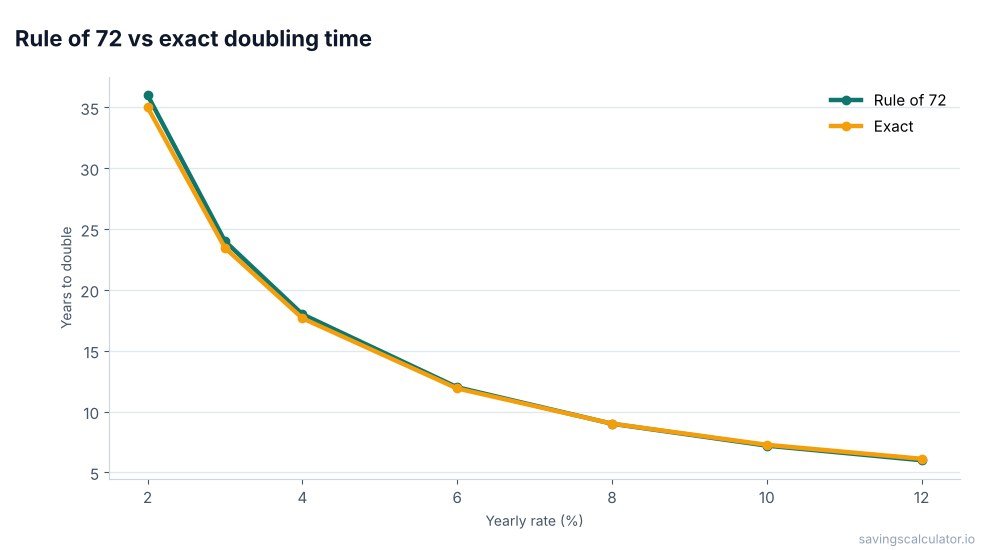
You may ask: why 72 and not 70 or 69? The exact math for continuous growth gives about 69.3. People pick 72 because it divides evenly by 2, 3, 4, 6, 8, 9 and 12. That makes mental math easy. Some people use 70 for very low rates and 74 for very high ones, but 72 is a good all-round number.
Tip: Want a closer answer at low rates? Use 70 instead of 72. At 2%, 70 ÷ 2 = 35 years, which matches the exact answer of 35.0 years.
Why does the rule of 72 work?
You do not need to know the math to use the rule. But a short look helps you trust it. Money doubles when (1 + r) multiplied by itself t times equals 2. Mathematicians solve this with a natural logarithm, and the answer for small rates is close to 69.3 divided by the rate.
That number, 69.3, is not easy to divide in your head. So people round it up to 72. The small extra helps because real accounts add interest in steps, not in one smooth stream. It also makes the rule fit better at the rates most savers see, from about 4% to 10%.
You can check it with one example. At 6%, the exact formula gives 11.90 years. The rule of 72 gives 12 years. The two answers differ by about one month. For quick planning, that is more than good enough.
What does doubling look like over time?
Doubling feels slow at first and fast later. That is the real lesson of the rule. Each doubling takes the same number of years, but each one adds a bigger amount of money.
Look at $10,000 at an example rate of 6%. The rule says it doubles every 12 years.
| After | Balance | What was added in this step |
|---|---|---|
| Start | $10,000 | None |
| 12 years | $20,122 | $10,122 |
| 24 years | $40,489 | $20,367 |
| 36 years | $81,473 | $40,983 |
The first doubling adds about $10,000. The second adds about $20,000. The third adds about $40,000. Time did the heavy lifting. The same 12 years gave a bigger gain each round.
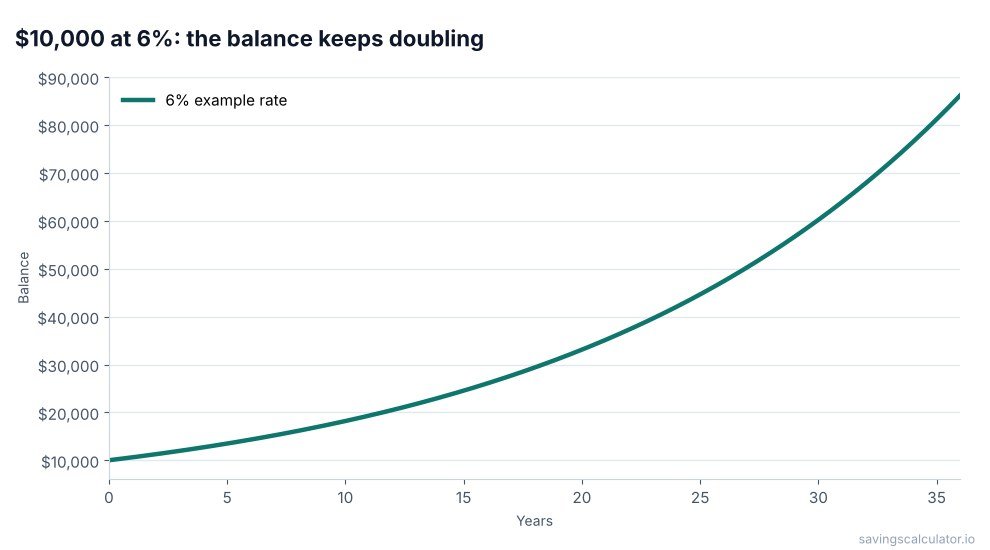
This is why starting early matters so much. If you start 12 years sooner, you get one extra doubling. You can test other start dates in our savings calculator.
How does the rule work with monthly deposits?
The rule of 72 is made for a single lump sum. When you add money every month, the doubling time of your whole pile is shorter, because new money keeps joining the pot. The rule still tells you how fast the money you already have will double, but it does not count the new deposits.
Here is a simple way to think about it. Say you start with $5,000 and add $200 a month at an example 6%. Your starting $5,000 follows the rule of 72 and doubles in about 12 years. But your deposits add a lot more.
After 12 years, your balance would be about $52,284. You put in $33,800 yourself. So the extra $18,484 is interest.
For a full answer with deposits, use our free monthly savings calculator. It does the long math for you.
Can you use the rule of 72 for inflation?
Yes. The rule works for anything that grows by a steady percent each year. That includes prices. If prices rise by 3% a year, divide 72 by 3. Prices double in about 24 years.
This is an important lesson for savers. A basket of goods that costs $100 today could cost about $200 in 24 years at a steady 3% inflation rate. That is why money kept in a very low-rate account slowly loses buying power. Our guide on how inflation affects savings goes deeper.
Here is a quick table of price doubling times.
| Inflation rate | Years for prices to double |
|---|---|
| 2% | 36.0 |
| 3% | 24.0 |
| 4% | 18.0 |
| 6% | 12.0 |
If your savings earn less than inflation, your money buys less every year. If they earn more, your buying power grows. Try the inflation savings calculator to see the effect on your own numbers.
What are the limits of the rule of 72?
The rule is handy, but it has limits. Keep these in mind.
- It assumes a steady rate. Real rates move up and down. A savings account rate can change at any time.
- It ignores taxes and fees. Both can reduce your real growth.
- It is less exact at very low or very high rates. Below 2% or above 20%, the gap grows.
- It does not count new deposits. It is built for one lump sum.
- It does not promise anything. It only describes the math of a given rate.
Careful: Do not use the rule of 72 to chase a very high rate. A promise of fast doubling is a warning sign. If a deal sounds too good, check it carefully and consider speaking with a qualified adviser.
How can you use the rule of 72 in real life?
Here are a few ways people use it.
- Compare accounts quickly. An account at 4% doubles in 18 years. An account at 0.5% would take 144 years. That helps you see why rate matters.
- Set realistic goals. If you want to double your money in 10 years, you need about 7.2% a year. Ask if that is a sensible target.
- Understand debt. Debt grows with compound interest too. A balance at 18% doubles in 4 years if you do not pay it down.
- Plan for the long run. With 36 years to go, a 6% rate gives three doublings. $10,000 becomes about $81,473.
Our APY calculator can help you compare the true yearly rate of two accounts. That makes the rule of 72 more useful because you can feed it the real APY.
What should you do next?
Here is a simple plan.
- Pick your current or example savings rate.
- Divide 72 by it to see your rough doubling time.
- Check the exact answer in the compound interest calculator.
- Think about whether more time or higher deposits would help more than a higher rate.
- Start now. Every year you wait costs you part of a doubling.
The rule of 72 will not replace a calculator, but it gives you a quick feel for how money grows. Use it for rough checks, then confirm the details when it matters.
Put your own numbers into our free Compound Interest Calculator. No signup. Works on any phone.
Frequently asked questions
What is the rule of 72 in simple words?
It is a quick way to guess how long money takes to double. Divide 72 by the yearly interest rate. If the rate is 6%, money doubles in about 12 years. It is a shortcut, so the answer is close but not exact.
How do you calculate the rule of 72?
Take 72 and divide it by the yearly rate as a plain number. For 8%, use 72 ÷ 8 = 9. That means about 9 years. To find the rate you need instead, divide 72 by the number of years you have.
Is the rule of 72 accurate?
It is quite accurate for rates between about 4% and 12%. At 8%, the rule gives 9.0 years and the exact answer is 9.0 years. At very low or very high rates, the gap gets bigger, and an exact calculator is better.
Why is it called the rule of 72 and not 70?
The number 72 divides evenly by many common rates, such as 2, 3, 4, 6, 8, 9 and 12. That makes mental math easy. Some people use 70 or 69.3, and those can be closer at low rates, but 72 is the favorite for everyday use.
Does the rule of 72 work for monthly compounding?
Yes, roughly. Monthly compounding gives a slightly higher yearly result than annual compounding, so money doubles a little sooner. For a close answer, use the APY instead of the plain rate. Our APY calculator can find it.
Can the rule of 72 be used for inflation or debt?
Yes. It works for anything that grows by a steady percent. At 3% inflation, prices double in about 24 years. A debt at 18% interest that is not paid down can double in about 4 years. It is a fast way to see how growth adds up.
How long does it take to double $10,000 at 5%?
Divide 72 by 5 to get about 14.4 years. The exact answer for yearly compounding is about 14.2 years. So $10,000 would become about $20,000 in a little over 14 years, if the rate stayed the same.
Is the rule of 72 a guarantee?
No. It is a math shortcut, not a promise. Real rates change, and taxes and fees can lower your results. Use it for rough planning only, and check your own account terms before you decide.
Please note: This guide is for education only and is not personal financial, tax or legal advice. Numbers in examples are simple estimates, not promises. Rates, fees and rules change, so check with your bank or a qualified adviser before you decide. See our disclaimer.
Free calculators for this guide
Compound Interest Calculator
Watch principal, contributions and interest build on each other over time.
Calculate Now →APY Calculator
Convert an interest rate and compounding frequency into APY.
Calculate Now →Savings Calculator
See how your savings could grow with regular contributions and compound interest.
Calculate Now →