The 50/30/20 Rule Explained With Simple Examples
A budget can feel like a puzzle with too many pieces. You have rent, food, fun and a wish to save, and no clear way to split the money. The 50/30/20 rule gives you a simple split to start with.
The idea is short. Spend 50% of your take-home pay on needs, 30% on wants and put 20% into savings. That is the whole rule. You do not need a spreadsheet or a finance degree to try it.
In this guide you will see the 50/30/20 rule worked out on $3,500 and $5,000 a month. You will also learn what to do when rent eats too much, and what your 20% could grow to. All rates here are examples, not promises.
The 50/30/20 rule says to split your after-tax income three ways: 50% for needs like rent and food, 30% for wants like fun and dining out, and 20% for savings and extra debt payments. On $3,500 a month that is $1,750, $1,050 and $700. It is a starting point, not a strict law.
- The 50/30/20 rule splits take-home pay into 50% needs, 30% wants and 20% savings.
- On $3,500 a month, the split is $1,750 for needs, $1,050 for wants and $700 for savings.
- On $5,000 a month, the split is $2,500, $1,500 and $1,000.
- Saving $700 a month at an example 4% rate could grow to about $103,075 in 10 years.
- If rent is high, try 60/30/10 or 60/20/20 and shrink the wants slice first.
- Treat the rule as a guide. Your own numbers matter more than the labels.
What is the 50/30/20 rule?
The 50/30/20 rule is a budget method that uses just three buckets. You take the money that lands in your bank account after taxes. Then you divide it by percentages. Half goes to needs. Thirty percent goes to wants. Twenty percent goes to savings.
It became popular because it is easy to remember. Most budgets fail because they are too detailed. You give up after two weeks of tracking every coffee. With three buckets, you only need to answer one question for each purchase: is this a need, a want or savings?
Here is the split in a picture you can keep in your head.
- 50% needs. Things you must pay to live and work.
- 30% wants. Things that make life nicer but are not required.
- 20% savings. Money for your emergency fund, goals and extra debt payments.
The rule is a guide, not a law. Some months you will be off by a few points. That is fine. What matters is that you pick a plan and follow it most of the time.
If you have never made a budget, our guide on how to create a monthly budget shows the full process. The 50/30/20 rule is a quick way to fill in the first draft.
What counts as needs, wants and savings?
The hard part is deciding which bucket a bill belongs in. A simple test helps. Ask yourself: if I stopped paying this for one month, would it hurt my health, my job or my home? If yes, it is probably a need.
What are needs?
- Rent or mortgage, plus basic utilities
- Groceries (not restaurant meals)
- Health insurance and necessary medical costs
- Transportation to work, such as a bus pass or car payment
- Minimum payments on any debt
- Basic phone and internet
What are wants?
- Dining out, takeout and coffee shops
- Streaming, games and hobbies
- Trips, concerts and gifts
- Upgrades, such as a faster phone you do not need yet
- Clothes beyond the basics
What goes in the 20%?
Savings means money you set aside for later. That includes your emergency fund, a goal such as a trip, and long-term saving. Many people also count extra debt payments above the minimum here, because paying down debt frees up money later.
Tip: Some items sit in the middle. A grocery trip is a need, but steak every night is a want. Split the bill in your mind: put the basic part in needs and the extra part in wants.
How do you find your take-home pay?
The rule uses take-home pay. This is the money that reaches your account after taxes and payroll deductions. It is not your salary before taxes. If you use the bigger number, your buckets will be too large and your budget will fail.
To find your number, look at three or four recent paychecks. Add up what you actually received in one month. If your pay changes, use the lowest typical month.
Some people have deductions that need a decision. Health insurance taken from your paycheck is already paid, so it is not part of your take-home. If your job also sends money to a retirement plan before you see it, you can count that as part of your 20%. Rules differ, so check your pay stub.
If you are paid every two weeks, add up a whole month first. Some months have three paychecks. Treat the third one as a bonus for savings or a sinking fund.
What does the 50/30/20 rule look like on $3,500 a month?
Meet Priya. She works as a dental assistant and takes home $3,500 a month. Let us run the rule for her.
Step 1: Needs are 50% of $3,500. That is $3,500 × 0.50 = $1,750.
Step 2: Wants are 30% of $3,500. That is $3,500 × 0.30 = $1,050.
Step 3: Savings are 20% of $3,500. That is $3,500 × 0.20 = $700.
Step 4: Check the total: $1,750 + $1,050 + $700 = $3,500.
Result: Priya can spend $1,750 on needs, $1,050 on wants and save $700 each month.
Now see how she might fill the buckets. Her rent is $1,100. Utilities and phone are $180. Groceries are $320. Transit and insurance are $150. That adds up to $1,750, right on the 50% line.
| Bucket | Share | Amount | What goes in it |
|---|---|---|---|
| Needs | 50% | $1,750 | Rent, utilities, groceries, transit, insurance |
| Wants | 30% | $1,050 | Dining out, streaming, hobbies, gifts |
| Savings | 20% | $700 | Emergency fund, trip fund, extra savings |
Her wants of $1,050 may seem large. Remember that wants include every fun thing: meals out, a haircut, a movie night and a birthday gift. When you add it up, $1,050 goes faster than you think.
What does the rule look like on $5,000 a month?
Now meet Marcus. He is an electrician who takes home $5,000 a month. The rule works the same way, but the amounts are bigger.
Step 1: Needs are $5,000 × 0.50 = $2,500.
Step 2: Wants are $5,000 × 0.30 = $1,500.
Step 3: Savings are $5,000 × 0.20 = $1,000.
Step 4: Check the total: $2,500 + $1,500 + $1,000 = $5,000.
Result: Marcus can spend $2,500 on needs, $1,500 on wants and save $1,000 a month.
Notice that a bigger paycheck does not change the percentages. It changes the dollars. This is useful. When Marcus gets a raise, the rule tells him how to split it. He can keep the 50/30/20 shape and enjoy more of every bucket.
A smarter move is to keep needs the same after a raise. If Marcus gets a $400 raise and his rent does not change, the extra money can go to savings. Then his savings share rises above 20%. That is how people build wealth faster without feeling squeezed.
| Bucket | On $3,500 | On $5,000 |
|---|---|---|
| Needs (50%) | $1,750 | $2,500 |
| Wants (30%) | $1,050 | $1,500 |
| Savings (20%) | $700 | $1,000 |
What if your rent is too high for the 50/30/20 rule?
In many cities, rent alone takes more than 50% of a paycheck. If that is you, the rule is not broken. It just needs a small fix. You have two main options, and both keep savings alive.
Option 1: 60/30/10
Needs go to 60%, wants stay at 30% and savings drop to 10%. On $3,500 that is $2,100, $1,050 and $350. It keeps your fun money but saves less.
Option 2: 60/20/20
Needs go to 60%, wants fall to 20% and savings stay at 20%. On $3,500 that is $2,100, $700 and $700. You trade some fun now for faster progress.
| Plan | Needs | Wants | Savings |
|---|---|---|---|
| 50/30/20 | $1,750 | $1,050 | $700 |
| 60/30/10 | $2,100 | $1,050 | $350 |
| 60/20/20 | $2,100 | $700 | $700 |
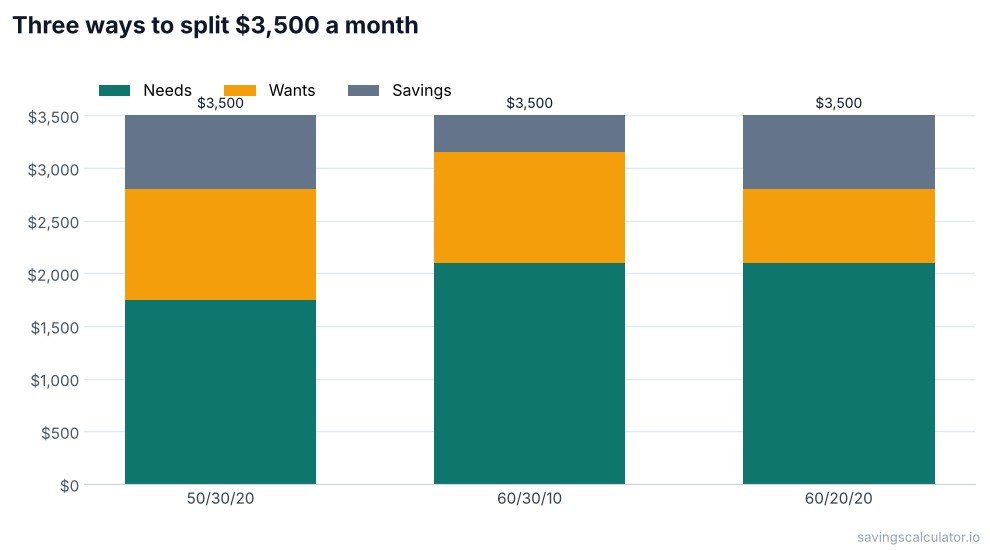
Which is best? It depends on your goals. If you have no emergency fund, protect the savings slice and cut wants. If you feel burned out, keep some fun and save a little less. Both are better than giving up.
Careful: Do not cut a need below what you truly require. Skipping insurance or food to hit a number is not a plan. If your needs are above 70% of your pay, look at raising income or lowering costs over time, step by step.
For help with very tight budgets, see our guide on how to save money on a low income.
What does your 20% grow to over time?
Savings do more than sit still. When you keep them in an account that pays interest, they earn money for you. Interest also earns interest, which is called compounding. You can read more in our guide on how compound interest works.
Let us use Priya's $700 a month. We will use an example rate of 4% a year, compounded monthly, with deposits at the end of each month. Real rates change, so treat this as a sketch.
Step 1: Priya saves $700 for 120 months. Her own deposits are $84,000.
Step 2: Interest is added every month at 4% ÷ 12.
Step 3: After 10 years the balance is about $103,075.
Step 4: Interest earned is $103,075 minus $84,000, which is about $19,075.
Result: Priya's 20% could grow to about $103,075 in 10 years. Of that, $19,075 is interest.
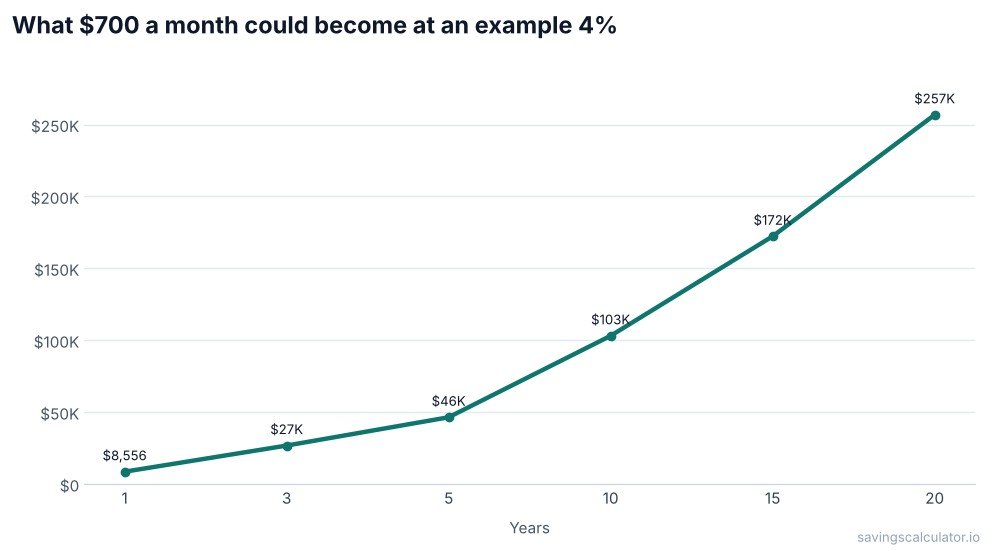
| Years | Estimated balance |
|---|---|
| 1 | $8,556 |
| 3 | $26,727 |
| 5 | $46,409 |
| 10 | $103,075 |
| 15 | $172,263 |
| 20 | $256,742 |
The curve gets steeper over time. The first years feel slow. Later, interest does more of the work. That is why starting early matters.
You can test your own numbers in our Monthly Savings Calculator. Enter your 20% amount, an example rate and a time frame, then press Calculate.
How much difference does the savings slice make?
Small changes in your savings amount make a big gap over time. Look at what different monthly amounts could become in 10 years at the same example 4% rate.
| Monthly savings | Share of $3,500 | Balance after 10 years |
|---|---|---|
| $100 | 2.9% | $14,725 |
| $250 | 7.1% | $36,812 |
| $350 | 10% | $51,537 |
| $500 | 14.3% | $73,625 |
| $700 | 20% | $103,075 |
Going from $350 to $700 a month roughly doubles the result, from $51,537 to $103,075. That is why the 20% target matters. It is also why a 10% savings rate is a fine start if 20% is out of reach right now.
If you are not sure how big your savings slice should be, read how much you should save each month. It explains how to pick a number that fits your life.
Marcus can see the same effect at a higher level. His 20% is $1,000 a month. At the same example rate, that could grow to about $147,250 in 10 years. A paycheck that is 43% larger gives a result that is also about 43% larger, because the math is a straight line in the deposit.
How do you start using the 50/30/20 rule this month?
You can begin today with a pen and paper. Follow these steps.
- Write your take-home pay. Use the lowest normal month.
- Do the three multiplications. Write the dollar limit for each bucket.
- Add up last month's spending. Use your bank app and sort each bill into needs or wants.
- Compare. See where you are over or under each limit.
- Adjust one thing. Pick the biggest gap and fix only that this month.
- Automate the 20%. Send it to a separate savings account the day you are paid.
Step six is the most important. If your savings money sits in checking, you will spend it. When it moves out on payday, it is gone before you can think about it. Our guide on how to start saving money has more ideas for building the habit.
Tip: Start with the number you can do. If 20% feels huge, try 5% for a month. Then move to 10%, then 15%. A habit you keep beats a target you drop.
What are the limits of the 50/30/20 rule?
No rule fits every life. Knowing the limits helps you use it wisely.
- It ignores your goals. If you want to buy a home in three years, 20% may not be enough.
- It ignores debt. High interest debt may need more than the 20% slice.
- It uses one rate for everyone. A person with low pay may need 70% for needs, while a high earner could save 40%.
- It is based on take-home pay. If your income swings, the dollars will swing too.
Where the rule is weak, adjust it. People with high debt may use 50/20/30, with the larger share going to savings and debt. Others with steady low needs may use 40/20/40. The labels do not matter. The idea is to decide on purpose.
Also remember that savings is not only a number. It is also what you do with it. Keep money for emergencies in a safe, easy-to-reach account. Money for goals many years away may be handled differently. Rules and products vary, so consider talking with a qualified adviser for personal advice.
What should you do next?
You now know how the 50/30/20 rule works, how to fix it for high rent and what your savings can become. Pick one small action today.
- Find your monthly take-home pay.
- Write down your 50%, 30% and 20% amounts.
- Try the Monthly Savings Calculator with your 20% and an example rate.
- Set up an automatic transfer on payday.
- Review your plan after 30 days and adjust.
If you want to turn a savings amount into a specific target, try the Savings Goal Calculator. For a clearer view of how the plan works with the tools on this site, read how to use a savings calculator.
Put your own numbers into our free Monthly Savings Calculator. No signup. Works on any phone.
Frequently asked questions
What is the 50/30/20 rule?
The 50/30/20 rule is a budget method. You split your after-tax income into three parts: 50% for needs, 30% for wants and 20% for savings and extra debt payments. It gives a simple starting point so you do not have to track every small purchase.
Is the 50/30/20 rule based on gross or net income?
It is based on net income, also called take-home pay. This is the money you receive after taxes and payroll deductions. If you use your pre-tax salary, your buckets will be too big and your budget will not match the money you actually have.
Does debt payment count as needs or savings?
Minimum debt payments count as needs because you must pay them. Extra payments above the minimum can count toward the 20%, since they free up money later. Many people split it this way: minimums in needs, extra in savings.
What if I cannot save 20%?
Start with what you can, even 5% or 10%. Use 60/30/10 if your costs are high, then raise savings when pay grows or bills fall. A small habit you keep is stronger than a big goal you drop after a month.
Is 50/30/20 good for low income?
It can be hard, since needs may take more than 50%. Try a version like 70/20/10 or 70/15/15, and focus on the savings habit first. The percentages are a guide. Check our low income guide for more ideas.
Should I use 50/30/20 for a high income?
You can, but you may be able to save more. If your needs are only 30% of pay, you could shift to 30/20/50. The rule is a floor for many people, not a ceiling. Higher savings can reach your goals sooner.
Where should the 20% savings go first?
Many people build a small emergency fund first, then fund other goals. Keep emergency money in a safe account you can reach fast. After that, split the rest between goals such as a trip, a home or long-term saving.
How often should I review my 50/30/20 budget?
Check once a month at first. Compare your real spending with your limits and change one thing. After a few months you can review every quarter, or whenever your pay, rent or life plans change.
Please note: This guide is for education only and is not personal financial, tax or legal advice. Numbers in examples are simple estimates, not promises. Rates, fees and rules change, so check with your bank or a qualified adviser before you decide. See our disclaimer.
Free calculators for this guide
Monthly Savings Calculator
Project future savings from a fixed monthly contribution.
Calculate Now →Savings Calculator
See how your savings could grow with regular contributions and compound interest.
Calculate Now →Savings Goal Calculator
Find out how much to save to reach a target, or how long a set contribution will take.
Calculate Now →