Compound Interest Formula Explained Step by Step (2027)
Many people see the compound interest formula and close the page. It looks like a puzzle full of tiny letters and raised numbers. The good news is that it has only four parts, and each one is easy to understand.
In this guide you will learn the compound interest formula one letter at a time. You will work three examples by hand: a single lump sum, regular deposits, and both together. Then you will check each answer against our free Compound Interest Calculator.
All rates here are examples only. Real rates change, and results are estimates, not promises.
The compound interest formula is A = P(1 + r/n)^(nt). A is the final amount, P is the money you start with, r is the yearly rate as a decimal, n is how many times interest is added each year, and t is the number of years. For example, $8,000 at 5% compounded monthly for 10 years becomes about $13,176.
- The formula A = P(1 + r/n)^(nt) has five letters: A, P, r, n and t.
- $8,000 at an example 5% compounded monthly for 10 years grows to about $13,176.
- Regular deposits need a second formula. $150 a month at 5% for 10 years grows to about $23,292.
- Compounding daily instead of yearly adds only about $158 on $8,000 over 10 years.
- Always write the rate as a decimal and match n and t to the same time units.
- Use a calculator to check your hand math before you rely on the answer.
What is the compound interest formula?
Compound interest means you earn interest on your original money and on the interest you already earned. Over time this snowball effect makes your balance grow faster. The formula is just a short way to write that idea.
You can read it like a sentence. Take your starting money. Multiply it by a growth factor, once for every time interest is added. The little raised part, called the exponent, tells you how many times to repeat the step.
If you want the idea without math first, read how compound interest works. Then come back here for the formula. For a comparison with the simpler version, see simple interest vs compound interest.
What does each letter in the formula mean?
Let us look at the letters one by one. We will use a running example. Lena has $8,000. She puts it in an account that pays an example 5% a year, compounded monthly. She leaves it for 10 years.
| Letter | What it means | Lena's value |
|---|---|---|
| A | Amount at the end | What we want to find |
| P | Principal, your starting money | $8,000 |
| r | Yearly rate as a decimal | 0.05 (that is 5%) |
| n | Times interest is added per year | 12 (monthly) |
| t | Number of years | 10 |
Why do we divide the rate by n?
The rate is a yearly number. If interest is added every month, each month only gets one twelfth of it. So 0.05 ÷ 12 gives a monthly rate of about 0.004167.
Why do we multiply n and t?
Interest is added n times each year for t years. So the number of steps is n × t. Lena gets 12 × 10 = 120 monthly steps. Each step multiplies her balance by the same growth factor.
Tip: The most common mistake is typing 5 instead of 0.05. Always change the percent to a decimal first. Divide the percent by 100: 5 ÷ 100 = 0.05.
How do you use the formula step by step?
Here is a simple routine. It works for any example. Write each number down before you press any buttons.
- Write the formula with your letters.
- Change the rate to a decimal.
- Divide the rate by n.
- Add 1 to that number. This is your growth factor.
- Raise the growth factor to the power n × t.
- Multiply the result by P.
Step 1: P = 8,000, r = 0.05, n = 12 and t = 10.
Step 2: The monthly rate is 0.05 ÷ 12 = 0.004167.
Step 3: The growth factor is 1 + 0.004167 = 1.004167.
Step 4: The number of steps is 12 × 10 = 120.
Step 5: The factor raised to 120 is about 1.6470.
Step 6: Multiply: $8,000 × 1.6470 = about $13,176.
Result: Lena's $8,000 could grow to about $13,176. Her interest would be about $5,176.
A basic phone calculator can do this if it has a power key. Many people use a spreadsheet instead. In a spreadsheet you can type =8000*(1+0.05/12)^(12*10) and press Enter. The result should match the number above.
How does the answer change year by year?
It helps to see the formula at work over a short time. Say Lena's bank adds interest once a year instead of monthly. Then n is 1, and the formula becomes simpler: A = P × 1.05^t.
Step 1: After year 1: $8,000 × 1.05 = $8,400.
Step 2: After year 2: $8,000 × 1.05 × 1.05 = $8,820.
Step 3: After year 3: $8,000 × 1.05 × 1.05 × 1.05 = $9,261.
Result: Each year you multiply by 1.05 again. After 10 years of yearly compounding, the balance is $13,031.
Notice that the dollar growth gets larger each year. Year 1 adds $400. Year 2 adds $420. Year 3 adds $441. That is the snowball. Your interest grows because the base it is figured on is growing.
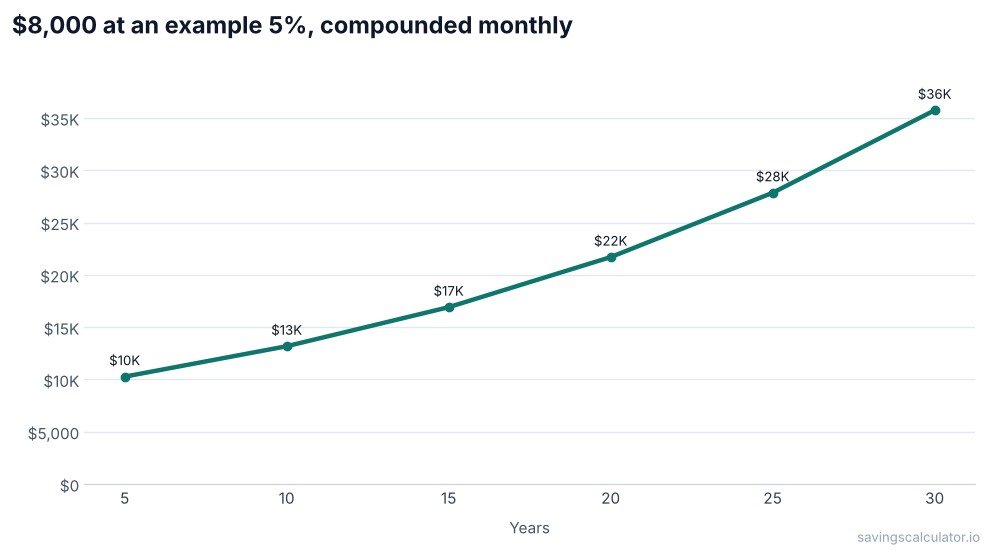
| Years | Balance |
|---|---|
| 5 | $10,267 |
| 10 | $13,176 |
| 15 | $16,910 |
| 20 | $21,701 |
| 25 | $27,850 |
| 30 | $35,742 |
Look at the gap between each row. From year 5 to 10 the balance rises by about $2,700. From year 25 to 30 it rises by more than $7,000. Time matters as much as the rate. You can see the same effect in our guide on how to calculate savings growth.
Does the compounding frequency change the result?
The letter n lets you test how often interest is added. Banks may compound yearly, quarterly, monthly or daily. You might expect big differences. In practice, the gap is small.
| Compounding | n | Balance after 10 years |
|---|---|---|
| Yearly | 1 | $13,031 |
| Quarterly | 4 | $13,149 |
| Monthly | 12 | $13,176 |
| Daily | 365 | $13,189 |
Going from yearly to daily adds about $158. That is less than $100 on $8,000 over 10 years. The rate and the time matter far more. A one-point change in rate does much more than a faster compounding schedule.
Compounding also shows up in APY, which is the yearly rate after compounding is included. Our guide on what is APY explains why APY is the best number to compare accounts.
How do you add regular deposits to the formula?
The first formula works for one lump sum. Most people add money every month. For that, you need a second piece. It adds up all the deposits and the interest on each one.
Here the letters r, n and t mean the same as before. PMT is new. It is your regular deposit. The fraction in the brackets is a growth factor for a stream of deposits. It already includes the interest each deposit earns.
Step 1: PMT = 150, r = 0.05, n = 12 and t = 10.
Step 2: Omar makes 120 deposits, so his own money is $150 × 120 = $18,000.
Step 3: Using the formula with monthly compounding, the future value is about $23,292.
Step 4: Interest earned is $23,292 minus $18,000, which is about $5,292.
Result: Omar's deposits could grow to about $23,292. About $5,292 of that is interest.
This is why our Savings Calculator asks for a regular contribution. It uses the same idea, step by step, one month at a time.
How do you combine a lump sum and monthly deposits?
Many savers have both. They start with some money and add more each month. In that case you add two parts together. Part one grows the starting money. Part two grows the deposits.
Step 1: The lump sum part is $13,176, from Example 1.
Step 2: The deposit part is $23,292, from Example 2.
Step 3: Add them. The total is about $36,468.
Step 4: Your own money is $8,000 + $18,000 = $26,000. The interest is about $10,468.
Result: The combined plan could grow to about $36,468.
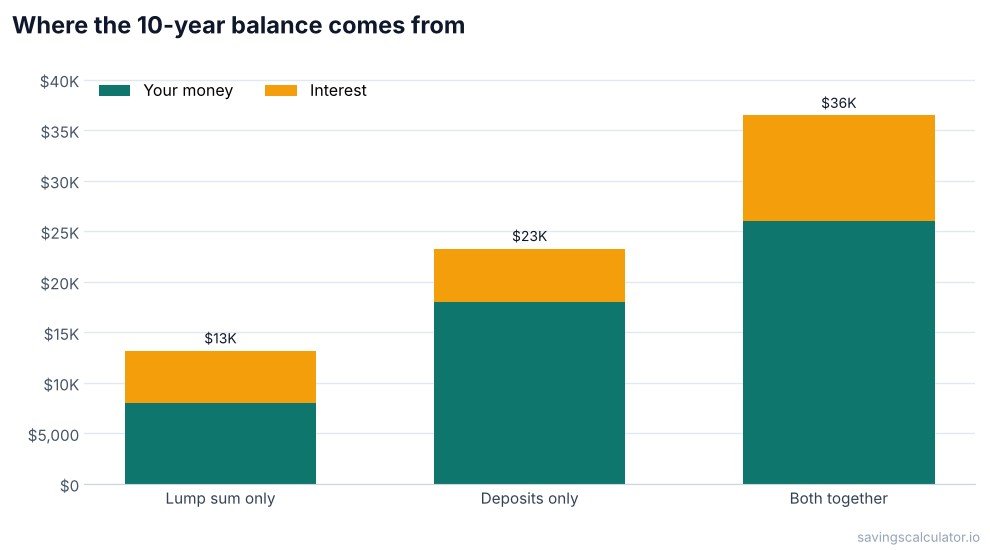
The chart shows how each piece helps. The lump sum is the bigger part at first. The deposits catch up over time, so keep saving even if your starting amount is small.
Careful: The formula assumes the rate never changes and that you never skip a deposit. Real accounts have variable rates. Treat every result as a rough guide.
How do you check your math with a calculator?
After you work a problem by hand, test it. Open the Compound Interest Calculator. Enter the same numbers in the matching boxes: starting balance, regular deposit, rate, compounding and years. Press Calculate.
The final balance should match your hand result, give or take a few dollars. Small gaps come from rounding. If the gap is big, check these common slips:
- You typed 5 instead of 0.05 for the rate.
- You used n = 12 but t in months instead of years.
- You forgot to divide the rate by n.
- The calculator counts deposits at the start of each period, while your formula assumes the end.
Deposit timing matters a little. Money added at the start of each month earns one extra month of interest. For $150 a month at 5% over 10 years, the start-of-month version ends higher by about $97.
| Rate | Balance |
|---|---|
| 4% | $34,014 |
| 5% | $36,468 |
| 6% | $39,137 |
What mistakes do people make with the formula?
The formula is simple, yet small slips can change the answer a lot. Knowing the common ones saves you time. Check this list whenever your hand math does not match the calculator.
- Typing the rate as 5 instead of 0.05. The formula needs a decimal. Divide the percent by 100 before you start.
- Forgetting the brackets. The exponent applies to the whole bracket, not just the rate. Work inside the bracket first, then raise it to the power.
- Mixing up n and t. The letter t counts years. The letter n counts how many times per year interest is added. The exponent is n times t.
- Rounding too early. If you round the bracket to two decimals, the final answer drifts. Keep every digit until the last step.
- Using the formula for deposits. The basic version has no regular deposits. For those, use the deposit version shown earlier in this guide.
If you are unsure, test the formula on a tiny case. Try $100 at 10% for one year with yearly compounding. You should get $110. If you do not, one of the steps above is off.
A good habit is to estimate first. Money at a few percent for ten years grows by a bit more than the simple total. If your answer is wildly higher or lower than that, stop and recheck the decimal point.
What should you do next?
You now know the compound interest formula, and you have used it three ways. A good next step is to try your own numbers.
- Pick a starting amount, a monthly deposit and an example rate.
- Work the formula once by hand or in a spreadsheet.
- Check it in the Compound Interest Calculator.
- Change one number at a time and see what moves the result most.
- Decide on a deposit you can keep up, and set up an automatic transfer.
If you are new to calculators, our guide on how to use a savings calculator shows each box. For plain-English background, read how to start saving money.
Put your own numbers into our free Compound Interest Calculator. No signup. Works on any phone.
Frequently asked questions
What is the compound interest formula?
The formula is A = P(1 + r/n)^(nt). A is the final amount, P is your starting money, r is the yearly rate as a decimal, n is how many times interest is added each year and t is the number of years. It shows how interest builds on itself.
How do I calculate compound interest by hand?
Change the rate to a decimal, divide it by n, add 1, raise the result to the power n × t, and multiply by your starting amount. A spreadsheet or phone calculator with a power key makes this quick. Then subtract P to get the interest.
What does n mean in the compound interest formula?
The letter n is the number of times interest is added in one year. Yearly is 1, quarterly is 4, monthly is 12 and daily is 365. A higher n means a slightly higher result, but the extra is usually small compared with the effect of the rate.
How do I find just the interest earned?
First find A with the formula. Then subtract your principal P. For $8,000 growing to $13,176, the interest is about $5,176. If you add deposits, subtract all of your deposits too, not only the starting balance.
Does the formula work with monthly deposits?
The basic formula covers only a lump sum. For regular deposits, add a second part: PMT × [((1 + r/n)^(nt) − 1) ÷ (r/n)]. Add the two results together. A calculator does the same steps for you and also handles weekly or yearly deposits.
How do I turn a percent into a decimal?
Divide the percent by 100. So 5% becomes 0.05, and 4.5% becomes 0.045. You can also move the decimal point two places to the left. Do this before you put the rate into the formula, or the answer will be wrong.
Is compound interest the same as APY?
They are related. APY is the yearly rate after compounding is counted. For example, 5% compounded monthly is an APY of about 5.12%. Banks show APY so you can compare accounts fairly. See our guide on APY for details.
Why is my answer different from the calculator?
Usual causes are rounding, a rate typed as 5 instead of 0.05, a mismatch between n and t, or deposit timing. Check that your inputs match the calculator boxes. If they do, the results should be within a few dollars.
Please note: This guide is for education only and is not personal financial, tax or legal advice. Numbers in examples are simple estimates, not promises. Rates, fees and rules change, so check with your bank or a qualified adviser before you decide. See our disclaimer.
Free calculators for this guide
Compound Interest Calculator
Watch principal, contributions and interest build on each other over time.
Calculate Now →Savings Calculator
See how your savings could grow with regular contributions and compound interest.
Calculate Now →APY Calculator
Convert an interest rate and compounding frequency into APY.
Calculate Now →